PI Briefing | No. 10 | Honduras Resiste
Celebrating International Women’s Day through Honduran resistance.
Happy International Women’s Day. Despite its attempted cooption by the corporations, states and international institutions that keep women down, International Women’s Day is a day of radical resistance.
Without the Socialist Party of America, Germany’s Rosa Luxemburg and Clara Zetkin, the Soviet Union’s Alexandra Kollontai, and the self-organisation of mainly immigrant women garment workers in New York City, International Women’s Day wouldn’t have been born. The struggles for equality and emancipation are constitutive of those for socialism, democracy and popular sovereignty.
In that spirit, we bring you news of resistance from Honduras. The country is led by its first female President, self-described democratic socialist Xiomara Castro. Last week, as her country took over the rotating presidency of the 33 member Community of Latin American and Caribbean States (CELAC), she asserted Honduran democracy and sovereignty by withdrawing from the International Centre for Settlement of Investment Disputes (ICSID).
Such a move is not a mere technical matter but one with life and death consequences for not just the Honduran people, but potentially the entire Global South. ICSID and so-called international arbitration courts like it are venues for corporations to force money out of states as compensation for public policies that advance the welfare of consumers, workers or the environment. In Latin America alone, more than $30 billion has been transferred from countries to corporations through these courts. And it’s not just the high price exacted by multinational corporations that must be resisted, it is the crippling, anti-democratic disincentive they have on governments to act in their people’s interest, rather than foreign corporations.
Honduras is in the crosshairs of such an assault. After a military coup in the country, a right-wing government pushed through extreme special economic zones that handed over Honduran land to foreign corporations to run outside of Honduran law.
As you might imagine, this provoked a major reaction in the country. The population mobilised and protested against such an anti-democratic assault on their sovereignty. Many groups participated, including PI members the political party Libre and the feminist organisation Luchemos. They coalesced behind the candidacy of Xiomara Castro, who pledged to scrap the zones, known as ZEDEs. In 2022, she won the presidency and in 2023 stirred the abolition of the ZEDEs through the National Assembly with unanimity.
The investors in the ZEDEs did not take such a mass, democratic expression of the popular will lying down. Delaware-based Honduras Próspera Inc, backed by Peter Thiel and other Silicon Valley figures, scuttled to ICSID, demanding almost $11 billion in compensation. Honduras’ entire GDP is less than $30 billion.
This scandal motivated the Progressive International to act in solidarity. Last year, we brought a high profile delegation to Tegucigalpa to support the government, provide technical support and defeat the ZEDEs. Today we renew our support, celebrate this bold act of resistance by the Honduran people and their government and commit to walk with them along the bumpy road to a New International Economic Order.
This week, the Chilean Senate passed the Comprehensive Law to Prevent, Punish and Eradicate Violence against Women with a large majority. The law, supported by PI member Convergencia Social is now a step closer to becoming law, with the Chamber of Deputies voting on it next.
In Argentina, the trade union federation and PI member CTA-T called for support for an International Feminist Strike on International Women’s Day, calling on all its affiliated unions in every sector to advance the claims of women and support their participation in demonstrations for International Women’s Day.
For Episode 6 of “The International,” a world-spanning video series brought to you by Jacobin and the Progressive International, journalist Abby Martin examines NATO’s global footprint and explains why this “defensive alliance” might end up causing World War III.
The original goal of the North Atlantic Treaty Organization (NATO), according to its first Secretary General, was "to keep the Soviets out, the Americans in, and the Germans down.”
Today, the Soviet Union is gone, the United States is dominant, and Germany is de-industrialising. Has NATO achieved its goals? If so, why does it still exist? And why did Fidel Castro call it “the most perfidious instrument of repression known to mankind”?
Watch the video here.
After a year of strikes and organising, Amazon workers in Coventry, England and their union the GMB have filed for union recognition. Amazon, as it does whenever it can get away with it, is resisting negotiating with the union. Recognition would force the company to sit down with GMB on matters relating to pay, worker safety, terms and conditions. In effect, it would Make Amazon Pay.
All across the world, people continue to take action for Palestinian liberation. In marches, sit-ins, blockades and boycotts, citizens are making themselves heard.
The world stands against Israel’s assault. Even in the United States, a new poll found that by a huge margin of 52 to 27 percent, voters want arms shipments from the US to stop. An arms embargo is a growing demand from the majority in nearly all countries on earth, as James Schneider and Peter Mertens both explained in media interviews in the past week.
PI member, the Central Workers Union (CUT) in Brazil, representing over 7.4 million workers, echoed this demand this week by calling on Brazil’s government to cancel all military cooperation with Israel, as well as operating an arms embargo.
Israel’s isolation grows by the day.
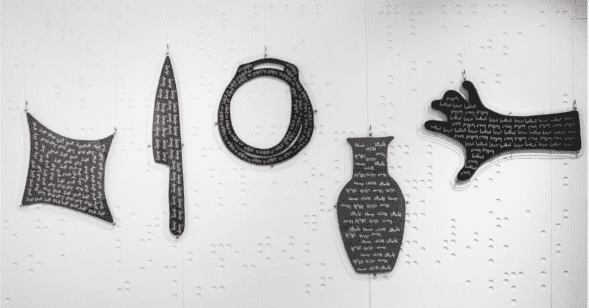
Amani Al Thuwaini (Ukraine, 1989) is a Kuwaiti artist and designer who responds to the commodification and changes of traditions and customs by incorporating insinuations of modernism, superficial display, commodity fetishism and gender.
Her series Weapons of Violence was created to raise awareness of honour killing – the the killing of a relative, especially a girl or woman, who is perceived to have brought dishonour on the family. It portrays domestic objects, which are often used as weapons of violence, including a pillow, knife, and vase.
Each work is digitally embroidered with words and phrases derived from the media and local newspaper articles telling stories about honour killing, for example “junha” meaning "minor crime" and "as if she is a mechanical object who doesn’t own her body."