Politics
Venezuela Secures UN Recognition of ‘International Day Against Unilateral Coercive Measures’
Venezuela successfully led a UN resolution, condemning sanctions' humanitarian harm despite opposition from the US and allies.
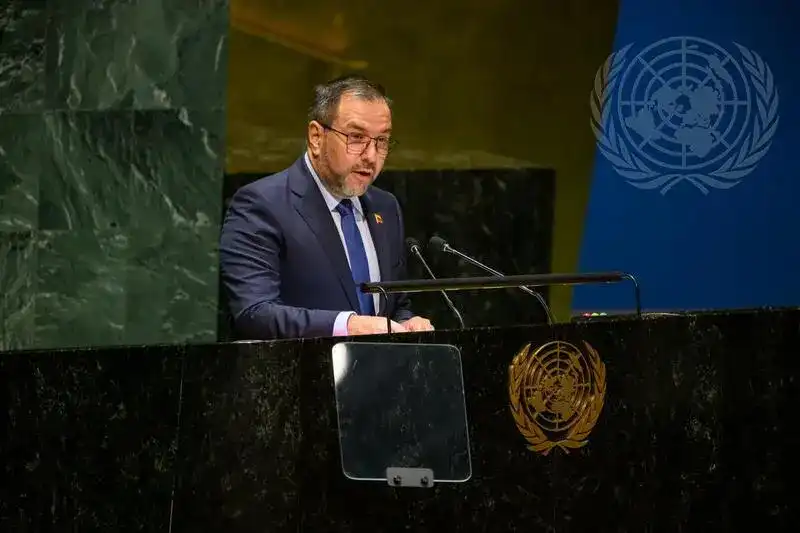
The Venezuelan government has welcomed the adoption by the United Nations General Assembly of December 4 as the International Day Against Unilateral Coercive Measures.
The resolution was approved on 16 June with 116 votes in favor, 51 against, and 6 abstentions.
Venezuela, on behalf of the 16-member Group of Friends in Defense of the UN Charter, proposed the date to raise awareness about the negative humanitarian impact of coercive measures and take a symbolic stance against this violation of international law. The US and its allies opposed the initiative.
Venezuelan permanent ambassador to the UN, Samuel Moncada, emphasized that an overwhelming majority of UN member states supported the initiative, following years of persistent efforts by Caracas. “Today is a great day for Venezuela,” Moncada stated, reflecting on the country’s long-standing struggle against coercive measures.
Venezuela has been subjected to unilateral coercive measures, commonly known as sanctions, imposed by successive US administrations targeting a range of economic sectors and particularly the nation’s most vital revenue source—its oil industry.
The measures have encompassed financial sanctions, an oil export embargo, a blanket ban on all dealings with Caracas, secondary sanctions, and the freezing or seizure of Venezuelan assets abroad. Oil sanctions alone have cost Venezuela an estimated US $25 billion in lost yearly revenue since 2017.
A 2019 report by the Center for Economic and Policy Research (CEPR) estimated that US coercive measures deprived Venezuelans of essential imports, resulting in tens of thousands of deaths between 2017 and 2018. Former UN Special Rapporteur Alfred de Zayas estimated over 100,000 deaths as a result of sanctions by early 2020.
Monday’s resolution urges UN member states to “refrain from adopting, promulgating, and applying any unilateral economic, financial, or trade measures that undermine the full realization of economic and social development, especially in developing countries.”
President Nicolás Maduro celebrated the annual observance of this day as a great victory for nations committed to sovereignty and multilateralism.
“It’s a tremendous struggle between those who seek to undermine international law and the UN itself, and the majority who are committed to revitalizing and rebuilding the UN,” stated Maduro on a Monday broadcast.
Many countries that backed the initiative condemned unilateral economic and trade sanctions, criticizing them as being driven by US foreign policy goals. Cuba, Iran, North Korea, and Syria have endured some of the longest-lasting sanctions programs, with extensive humanitarian consequences documented over decades.
Eritrea’s UN ambassador, Sophia Tesfamariam, emphasized that these measures are “tools of political and economic compulsion” and “punish millions of people worldwide.”
Similarly, Zimbabwe’s representative, Ever Mlilo, endorsed the initiative on behalf of the Southern African Development Community (SADC). Mlilo explained that Zimbabwe has endured unilateral sanctions for over two decades, which have hindered the country’s access to trade and investment and have slowed infrastructure development.
Cuba’s Deputy Minister for Foreign Affairs, Elio Eduardo Rodríguez Perdomo, denounced the 63-year-old US blockade on Cuba as “an unwavering, pitiless war” against the Cuban people. “The goal is to break the political will of our country.”
For his part, Venezuelan Foreign Affairs Minister Yván Gil rejected the US and European allies’ narrative that coercive measures only target individuals and called the alleged humanitarian exceptions a “fantasy.”
In 2021, UN Special Rapporteur Alena Douhan conducted a visit to Venezuela and concluded that wide-reaching US sanctions had a “devastating” impact on the population’s living conditions and that “humanitarian exemptions” have proven largely ineffective in alleviating these hardships due to the phenomenon of “overcompliance.”
On Tuesday, Gil took part in the High-Level International Conference for the Peaceful Settlement of the Question of Palestine and the Implementation of the Two-State Solution, as well as the 9th Plenary Session of the Special Committee on Decolonization (C-24). During both events, the Venezuelan minister condemned the ongoing US-backed Israeli genocide and blockade in Gaza, and reaffirmed Puerto Rico’s right to self-determination.
Edited by José Luis Granados Ceja in Mexico City, Mexico.