Briefing
PI Briefing | No. 11 | Medicine for Minerals
From HIV treatment in Zambia to deportations to the Democratic Republic of the Congo, a new US strategy seeks privileged access to critical minerals in Africa.
For years, Zambia’s HIV medicines arrived in clinics and pharmacies from a familiar source: PEPFAR, the US programme founded in 2003 that saved more than 25 million lives.
Now, that lifeline is being turned into leverage. US officials have warned that future HIV funding could depend on access to Zambia’s copper reserves — part of a wider push to secure the minerals that power everything from electric vehicles to missile systems. A leaked State Department memo suggests Washington has even considered withholding HIV, tuberculosis, and malaria medicines to force access to the country’s mines.
The bargain is brutally simple: medicine for minerals.
And Zambia is not isolated case. Across the continent, a new doctrine is taking shape. In Zimbabwe, negotiations reportedly collapsed after US demands extended to health data. In Kenya and elsewhere, bilateral “health partnerships” are expanding — opaque in structure, expansive in scope. The language of humanitarianism sometimes remains. The terms have changed.
Health systems are being folded into negotiation tables — alongside mines, ports, and security.
Behind these deals lies a deeper shift in US strategy. In Munich this year, Secretary of State Marco Rubio set out the objective in blunt terms: “creating a Western supply chain for critical minerals not vulnerable to extortion from other powers; and a unified effort to compete for market share in the economies of the Global South.” In the same speech, he reflected on the collapse of European empires at the hands of “godless communist revolutions and anti-colonial uprisings” — less as a reckoning for the criminal expansion of empire, but as their unjustified loss that must be reversed.
Critical minerals sit at the centre of that project of recolonization: the materials without which Washington cannot build its batteries, chips, drones, missiles, or military supply chains.
That strategy is now landing on African soil. From the Lobito Corridor in Angola to new “commercial diplomacy” initiatives across Central and East Africa, Washington is constructing a new infrastructure of extraction: railways, ports, and financing mechanisms designed to lock African mineral flows into US-controlled supply chains. Copper, cobalt, lithium, rare earths — the materials of the 21st century — are being mapped, priced, and secured.
Those materials reach deeper than Africa’s subsoil. They also reframe Africa’s place in the global division of labour.
This is a competition with China, certainly. But it is also something older: resources out, dependency in. And the coercion does not stop at contracts.
The Democratic Republic of Congo — one of the most resource-rich countries on earth — has also been drawn into another dimension of US policy. Migrants deported from the United States, including Colombians and Peruvians, have been sent to Kinshasa. Plans have been discussed to relocate Afghan refugees stranded in Qatar to the same country.
A nation whose minerals are indispensable to the global economy is being asked, at the same time, to absorb the human consequences of wars and borders not its own. Extraction and displacement: twin processes in a single colonial dynamic.
Taken together, these developments mark a shift in imperial strategy. For decades, Western power in Africa was lubricated by development — however unequal and conditional. Aid, debt, NGOs: a language of partnership masking a structure of control.
That settlement is breaking down. In its place emerges a harder bargain. Africa is not being “integrated” into the green transition. It is being positioned as its supply zone.
But this strategy is already encountering resistance. In Nairobi next month, as governments gather for the France–Africa Summit — billed as a forum for climate cooperation and investment — movements are preparing a parallel mobilisation.
Organised by the Communist Party Marxist - Kenya and allied forces, the Pan-Africanism Summit against Imperialism will bring together parties, trade unions, and grassroots organisations from across the continent and beyond. Its purpose is to expose what it describes as a new phase of recolonisation, and to build a coordinated response rooted in popular power.
The context is combustible. In 2024, mass protests swept Kenya against IMF-backed austerity measures, met with arrests, killings, and disappearances from a state embedded in Western security and financial architecture. Today, that same country is being positioned as a gateway for renewed military, economic, and ecological intervention — as foreign powers court it as a hub for “green” investment.
This is a struggle over sovereignty itself: who controls land, labour, resources, and the direction of development. Their call is for a continental and international front capable of resisting military bases, extractive finance, and what they term “green colonialism.”
If the new imperial strategy is being assembled through contracts, corridors, and coercion, its counterforce is beginning to take shape in movements, alliances, and uprisings from below.
The outcome is not yet decided. But the terms are becoming clearer. What follows will be shaped not in conference halls alone, but in the struggles now unfolding across the continent — over mines and medicine, borders and bodies, sovereignty and survival.
A new campaign led by Courage Foundation is mobilising across Europe to confront Washington’s assault on international law, after the United States sanctioned UN Special Rapporteur Francesca Albanese and targeted judges and officials of the International Criminal Court under Executive Order 14203. The “Demand Justice” petition calls on the European Commission to activate the EU Blocking Statute — prohibiting compliance with US sanctions, protecting those targeted, and forcing banks and institutions to continue working with them. You can sign the petition here.
From 2-4 May, the world’s most renowned economists will come together in Bogotá alongside academics, public policy decision-makers, and social scientists for a discussion on building economic alternatives and formulating programmatic proposals in response to the challenges of the current international economic order.
Convened by the Government of Colombia, the Progressive International —and with the support of the Centro de Pensamiento VIDA— the event will include keynote lectures, panels, plenary sessions, and a "Festival of the Economies of Life" which invites the Colombian public to engage in a dialogue on the Global South within the international order. The meeting will bring together figures including Gustavo Petro, David Harvey and Jayati Ghosh to advance proposals on sovereign control over resources, debt restructuring, and public investment at scale. Find out more here.
Lenin
Vladimir Ilich Ulyanov, known by his pseudonym Lenin, was born on 22 April 1870.
Lenin was among socialism’s great pathfinders: a relentless thinker who insisted on a “concrete analysis of the concrete situation” against the dogma of his time. In 1896, when spontaneous strikes erupted across St. Petersburg, he saw that the movement lacked the “constant and continuous organisation” needed to turn revolt into power — a lesson that shaped his politics thereafter. Two decades later, after the February Revolution of 1917 toppled Tsarism and installed a liberal government committed to continuing the war, Lenin identified a different source of authority: the soviets, workers’ councils that embodied a rival form of power. The task of revolutionaries, he argued, was not to substitute themselves for the masses, but to win them — through “patient, systematic, and persistent” explanation — to the necessity of transferring power to these organs.
Less than ten months later, that strategy culminated in the October Revolution, as workers seized power and set about dismantling the old order. In State and Revolution, Lenin argued that the bourgeois state could not simply be taken over, but had to be “shattered” and replaced with new institutions rooted in popular control. His analysis extended beyond Russia. In Imperialism: The Highest Stage of Capitalism, he described a world system structured by monopoly and finance capital, in which wealth in the imperial core depended on the subordination of the periphery. This framework would guide the Third International’s support for anti-colonial struggles — an effort to break the chains of extraction that divided the world into rich and poor, and to link the fate of workers in the metropole with those fighting for liberation across the Global South. You can read more about Lenin here and mark his date of birth.
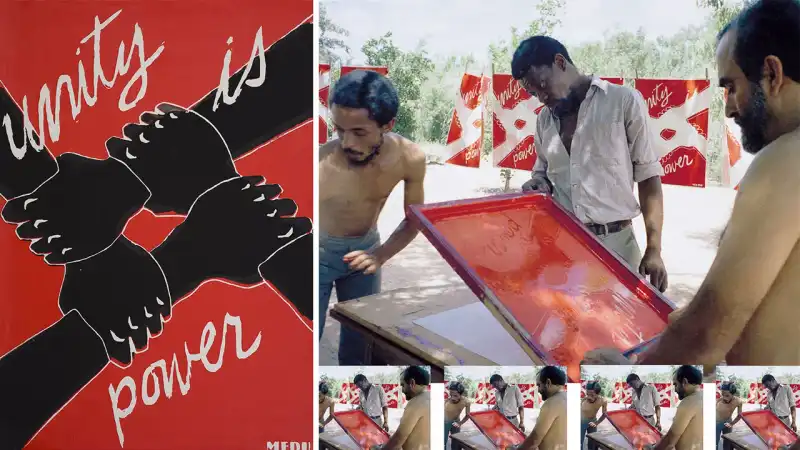
Medu Art Ensemble (1979–1985, Gaborone, Botswana) was a Pan-African, multiracial, and anti-colonial collective of over 60 cultural activists including musicians, performance artists, writers, and poets. Medu means roots in Sepedi. Most Medu cultural workers were South African, having been forced into exile following the deadly Soweto uprising. They played a significant role in defining cultural resistance to apartheid through exhibitions, educational events, and poster production.
In 1976, Soweto was the site of various school protests against learning in Afrikaans, the "language of the oppressor." Estimates suggest there were as many as 700 fatalities among the 20,000 students who took part in the protests. Teresa Devant was one of the first white international artists to join the Ensemble, photographing the events and organising activities, including the printing of the Unity is Power poster in 1979. The image rights holder is Freedom Park, accessed via the UCLA Digital Library.