Entrevistas
“Our fight is for the workers”
Gig worker union leader Shaik Salauddin on Indian gig workers organising a successful strategic strike against exploitative "10-minute delivery" models.
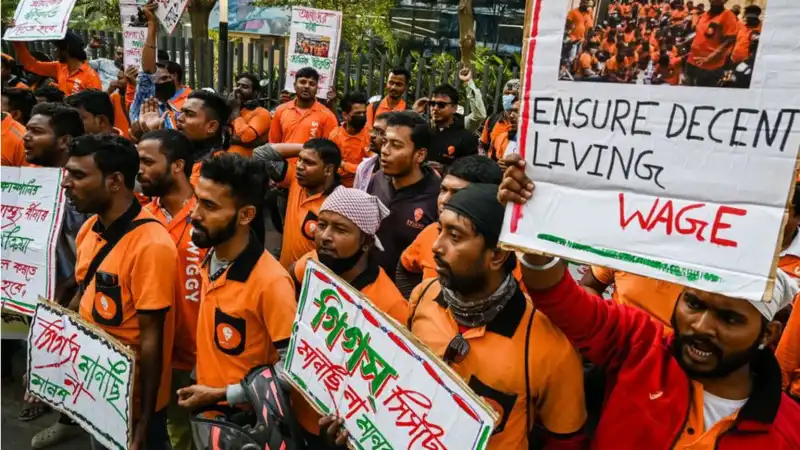
Editorial note: On 13 January 2026, as a result of the flash strikes organised by TGPWU, an intervention from the Union Government of India directed the quick commerce apps not to advertise the 10-minute delivery promise on their platforms. Companies such as Zomato, Blinkit, Swiggy and Zepto were asked to comply. In a statement, Shaik Salauddin welcomed this win, calling it a “much-needed step in protecting the lives and dignity of gig and platform workers.”
Tanya Singh: Could you tell us why and how you organised the flash strikes against the quick commerce apps offering 10-minute delivery?
Shaik Salauddin: Gig workers in India face harsh working conditions. The 10-minute delivery stipulation offered by the quick commerce apps means that workers put their lives at risk to make sure they deliver within or under 10 minutes. So, the stress is both mental and physical.
Just look at the traffic conditions workers have to navigate. There are no easy U-turns; there are only long, unmoving lines of traffic. In cities like Hyderabad, Bangalore, Delhi, and Mumbai, it's back-to-back traffic for hours on end. What these companies don’t understand is that making policies in a boardroom is one thing. You have to come out of the boardroom and look at the consequences of your policies.
We had communicated with the quick commerce companies about the realities being faced by the delivery workers of India, and before embarking on the strike, we had sent them a notice informing them of the flash strike.
Meanwhile, across India, we instructed all our affiliations to organise. We presented our plan to the workers, listened to their thoughts, and made our stance clear: higher pay, safer working conditions and rollback of the 10-minute delivery mandate. And all the workers agreed. We were also clear with them: this was a strategic flash strike, not an all-out stoppage. We wanted to demonstrate how to apply effective pressure while still protecting our livelihoods.
On 25 December, the Telangana Gig Platform Workers Union called for a flash strike, which was a success. That day, we mobilised 40,000 delivery workers. As planned, we were on strike again on the 31st.
TS: What was the response to the flash strikes by the quick commerce companies?
SS: The companies fought back with their money and muscle power, but they weren't as successful as they'd hoped. For a solid 3-4 hours, orders were delayed, and the pressure on them was intense. Eventually, they resorted to offering incentives of Rs. 125 to 150 per order to the workers to break the strike and even involved the police. Still, the strikes were a triumph.
You must have read on X, Deepinder Goyal [owner of Blinkit and Zomato quick commerce apps], losing his patience and writing about how the strike was unsuccessful.
TS: He claimed that Blinkit and Zomato delivered over 70 lakh (7 million) orders, despite the strike.
SS: What he doesn't mention is that this is a much lower figure than last year. In his rant on X, he kept saying that he is spending 100 crores (1 billion) on these ventures. In response, I asked him to explain that if he is indeed spending that amount, why aren’t the workers receiving insurance payouts when they are injured in an accident? He had no answer for me. However, I answered all his questions with facts.
The media also tried to spin a narrative against us workers, but the people listened to us. Many people boycotted the apps, instead choosing to buy in person. And that is something he will never talk about.
TS: After the success of the strikes, how are you carrying the momentum forward?
SS: We are committed to this fight; however, we are waiting for the right moment to build on this momentum, as we must be strategic. This is just the beginning; a lot is still left to be done.
This fight is for the workers, and the union is here as a backbone of support. Our role was to take cognisance of the workers' problems and highlight them for the public. Our goal was to mediate and resolve the issues—that is what we want.
We wanted companies to come to the table and have a discussion with us. If they don't want to talk to the union, then talk directly to the workers. The union will step back. But they must talk. They must try to understand the problems. This is all we are asking for. We have never refused dialogue. We never said we won't sit together or talk. We are ready.
TS: You mentioned that you received encouragement from workers' unions across the world for the flash strikes. How crucial was this support?
SS: First, I would like to thank everyone—locally, nationally, and internationally—who has supported us. My gratitude goes to the Telangana Gig and Platform Workers Union (TGPWU), the Indian Federation of App-based Workers (IFAT), and all the leaders and federations who stood with us in this moment.
We will fight together, because this is not just an issue for one state or one country. This is a global struggle. That is why, moving forward, we are committed to supporting workers everywhere. Our umbrella organisation, the International Alliance of App-based Transport Workers (IAATW), aims to build on this solidarity and put pressure on these platform companies—not just here but globally—to offer dignity to our workers. The fight is growing, expanding.
Salauddin has worked with app-based ride-hailing companies since 2012 and has been a driver-organizer in Hyderabad since 2014. In his role as an organizer, he founded Telangana Four Wheeler Driver's Association to represent the interests of outsourced, contracted and other private drivers. He is also the founder-President of Telangana Gig And Platform Workers Union (TGPWU), a member organisation of the Progressive International.