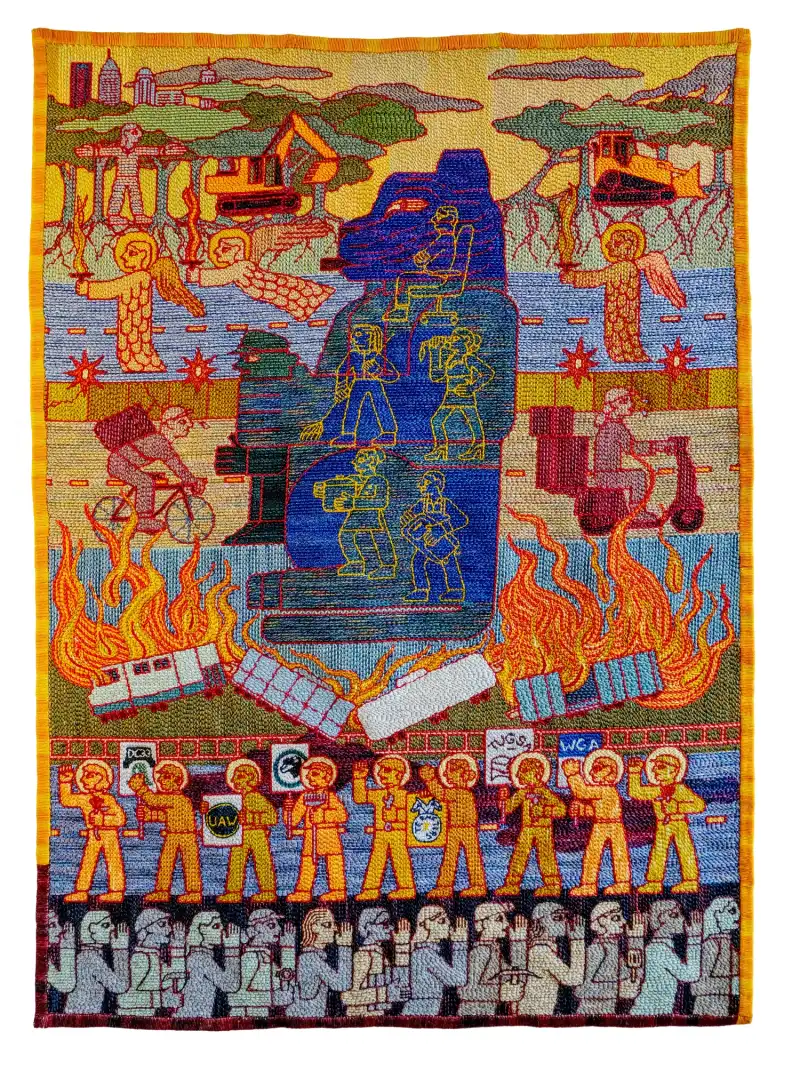
Briefing
PI Briefing | No. 35 | The Struggle for the International Order
On its 80th birthday, the UN is a battleground over the future of international institutions.
In October 1945, the nations of the world adopted the United Nations Charter — a document with unprecedented global consensus and bold aspirations to build a new world from the ashes of two brutal wars. Months later, the first UN General Assembly was held.
From its birth, the institution would mirror the contradictions and inequalities of a world system shaped in the crucible of the colonial encounter. Only 51 nations were present at the first General Assembly. When they met in London’s Methodist Central Hall, some 750 million people — or a third of the world’s population — remained under colonial rule.
The very architecture of the UN, which gives the US and its allies significant power through the Security Council, would long serve an agenda of imperial encroachment. It was with UN Security Council approval that the US launched its genocidal assault on Korea just five years after the UN Charter expressed the world’s determination “to save succeeding generations from the scourge of war.”
Still, the decades that followed saw seismic changes in the international system. As national liberation movements — and socialist revolutions — liberated peoples across the Global South from colonialism and imperialism, they entered the international system determined to build a world free from domination.
They met in Bandung, Belgrade, or Havana, to articulate a vision of a world of peaceful cooperation and sovereign development. And, in the halls of the UN, they made historic efforts to reconfigure international law — and the institutions designed to uphold it — in the image of the world’s oppressed.
It was through this intersection of struggles that the nations of the Third World won the right to armed struggle against colonial occupation (UN Resolution 37/43), sanctions against South Africa’s apartheid system (UN Resolution 1761), and the Declaration on the Establishment of a New International Economic Order (UN Resolution 3201).
Each initiative was, to a greater or lesser extent, thwarted or contained by imperialist powers. And underlying these episodes is a sober reality: the UN simply reflects the contradictions in the world system and the balance of power between the nations that comprise it. Today, as it convenes for its 80th General Assembly, those contradictions have reached a sharp new stage.
On one side, there is a renewed effort by states from the Global South to bend the international system towards the interests of the global majority. A key example is The Hague Group, a global bloc of states committed to “coordinated legal and diplomatic measures” in defense of international law and solidarity with the people of Palestine. The Hague Group arrives at the United Nations with an extended agenda to deliberate a joint response to the genocide and showcase national anti-Israeli policies to the General Assembly.
The Hague Group’s New York interventions build on its recent Emergency Conference for Palestine, held in Bogotá on 15-16 July, which brought together representatives from 31 countries across Latin America, Africa, Asia, Europe, and the Middle East, marking the most coordinated diplomatic effort yet by a coalition of states opposing Israel's genocidal onslaught in Gaza. Now, states are gathering to take that proposal forward — aiming to bring new states on board while deepening the commitments they made earlier in the year.
On the other side of this historic struggle, there is a renewed effort by the US and its allies to dismantle the consensual international system in favor of an uncodified and undefined “rules-based international order” — an arbitrary framework of imperial lawlessness and impunity. It finds reflection in Annalena Baerbock’s assumption of the UN General Assembly Presidency, which makes a mockery of the institution. As former Foreign Minister of Germany, Baerbock was among Europe’s loudest cheerleaders for NATO and the genocide in Palestine.
And it finds reflection in the toothlessness of the UN system. The US veto at the UN Security Council — which it has exercised more than forty times to protect the Israeli occupation of Palestine since 1972 — obstructs any meaningful prospect of reprieve for the Palestinian people. And the UN General Assembly has no meaningful power to enforce measures it puts forward. Despite occasional words of condemnation from UN leaders, the genocide continues unabated — even UN staff have not escaped the onslaught.
That is why initiatives like The Hague Group are so important. They show that the rights won — often at the barrel of a gun — for the world’s oppressed peoples within the international system are not dead and buried. Instead, they remain a living terrain of struggle. They reflect the balance of power within the international institutions, and that balance is now tipping. Whether this struggle succeeds will depend on the capacity and determination of progressive forces around the world to take the long struggle for liberation into a new era.
Wire partner Jamhoor is partnering with other media publications to offer a six-month fellowship programme designed for early- to mid-career journalists from the Global South. The fellowship supports journalists committed to feminist and social justice values, offering resources, mentorship, and visibility to strengthen reporting that challenges fascism, fundamentalisms, and anti-gender movements. You can read more and apply here.
A new report by Blueprint partner Commonwealth reveals the devastating scale of Britain’s privatization since the 1980s. It shows that £200 billion has been paid to shareholders of privatized industries like energy, water, and transport, costing households £250 annually since 2010. That privatization has led to underinvestment, rising bills, and deteriorating services, with foreign and private entities now owning these essentials. You can watch a short video about the report here.
Reactionary International exposes the gig economy's "Uber playbook": a deliberate strategy of breaking laws and influencing politics to avoid regulation. Leaked files show a coordinated global effort to deregulate markets by force, systematically exploit workers by misclassifying them to deny fair wages and benefits, and shifting all risk onto them. Ultimately, this exploitation is masked as empowerment through lobbying and dark money, a blueprint now expanding into the vulnerable economies of the Global South. Read the case here.
This tapestry, based on Pablo Picasso’s famous painting, hangs in the New York City Headquarters of the United Nations. It was woven by Atelier J. de la Baume-Durrbach in Southern France in a process that was supervised by the artist.
Pablo Picasso created Guernica in his Paris studio during 1937, responding to a commission from the Spanish Republic to produce artwork for Spain's pavilion at that year's Paris International Exposition. The painting takes its title from the Basque town of Guernica, which had been devastated by aerial bombardment during the Spanish Civil War.
Rendered in monochromatic tones of black, white, and gray, the work conveys the brutality of warfare through its fragmented imagery of tormented human and animal figures caught in destruction and mayhem. In the United Nations today, it sits as a reminder that the era of war is far from over.