When the Neoliberal Playbook Clashes with the Plurinational State
News from Latin American countries where the right has returned to power seems to follow a predetermined script. Governments whose leaders attended the Summit of the Americas replicate, with local nuances, the same political logic: structural reforms aimed at propping up big business; alliances between national business elites and Washington’s strategic interests; political persecution of social leaders; the use of law enforcement to suppress protest; stigmatization of the popular movement; and the return of religion as a tool for ideological legitimization.
Bolivia is no exception to this playbook. Six months into Rodrigo Paz’s administration, the country seems to be living in a state of constant upheaval. The package of decrees and laws promoted by the executive branch—focused on the privatization of strategic resources, economic liberalization, and the reduction of the state’s role (DS5503)—combined with inflation, government mismanagement, broken promises, the attempt at agrarian reform, and the constant underestimation of the popular bloc as a political actor, has strained institutional stability to the breaking point. The demands of social organizations no longer revolve solely around the repeal of specific laws; today, the mobilization directly demands Paz’s resignation.
Bolivia and the Return to Permanent Crisis
The social crisis Bolivia is undergoing did not emerge in recent weeks. It is the result of historical fractures and political wounds reopened following the 2019 crisis. The exclusion of social organizations from decision-making, along with economic policies that benefit only a small minority—such as the elimination of the tax on large fortunes—has brought back to the surface the structural problem that Bolivia never fully resolved: the persistence of internal colonialism.
The old oligarchic logic—which holds that the country must be governed by a “qualified” elite because indigenous and working-class sectors “do not understand” how the state functions—is reemerging with force. Bolivia seems to have returned to a stage where the country is no longer governed by those who resemble the majority of the population, but by those who historically viewed politics as a hereditary and exclusionary domain.
“Bolivia is not for sale” and the return of mobilization
The immediate precursor to the current conflict lies in the great march of 2025, which paralyzed the country for two weeks and ultimately forced the government to back down on its first package of privatization measures. As is often the case in Bolivia, it took only a few hours after the announcement of the reforms for social organizations to begin a process of grassroots outreach, explaining to unions, communities, and neighborhoods the consequences these policies would have on daily life.
The “Bolivia is not for sale” mobilization succeeded in repealing DS5503 and marked the return of a capacity for social coordination not seen since the beginning of the century. The scenes inevitably recalled the major protest cycles of the Water War and the Gas War: self-organized mobilizations, activated union structures, and a popular narrative based on the defense of national resources against external interests.
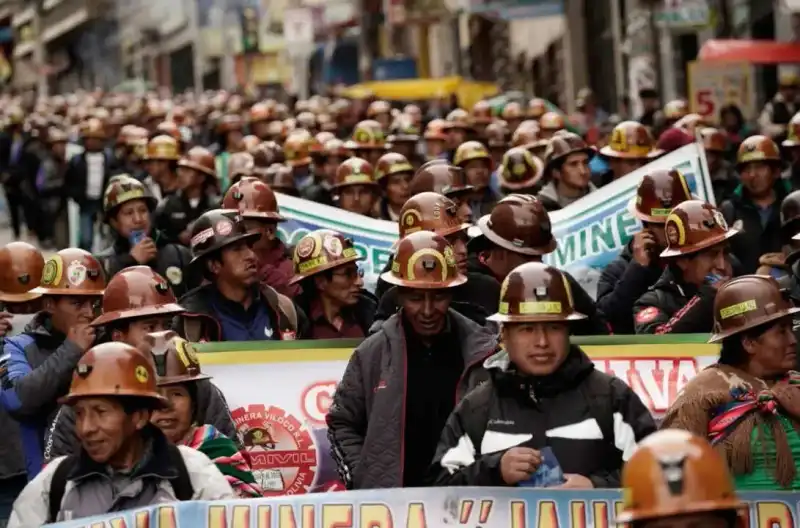
Today, the situation is even more complex. The national blockade led by the peasant sector and backed by the Bolivian Workers’ Confederation, alongside coca growers, rural teachers, mining cooperatives, and neighborhood councils, reflects a deep sense of exhaustion in the face of the government’s political impotence. For a significant portion of the social movement, there is no longer any room for negotiation. The prevailing view is that the Paz administration never understood the nature of the Bolivian conflict and that it governed the country as if grassroots organizations were secondary actors rather than the primary structure of political stability built since 2006.
The Failure of Neoliberal Restoration
The failure of the new neoliberal cycle lies precisely in this historical misunderstanding. The economic vision of Paz and his team seems limited to replicating models promoted by the United States and international financial institutions: unrestricted market opening, reduction of the state, and export liberalization. However, Bolivia never developed a solid industrial economy capable of sustaining such an opening without deepening inequalities.
During the fourteen years of the Movement Toward Socialism (MAS-IPSP) government, there was at least one attempt to alter the historical logic of exporting natural resources at low cost while wealth was concentrated in a few hands. The liberalization of exports and the benefits to large agro-industrial sectors generate foreign exchange that often does not effectively return to the national economic circuit. Export growth may improve certain macroeconomic indicators, but it is irrelevant to a population whose purchasing power deteriorates day by day. The problem is not merely how much the country exports, but who benefits from that wealth.
The Return of the “Apparent State”
Another of Paz’s major mistakes was assuming he could govern without relying on organized social bases. From the start of his term, the government treated unions, indigenous organizations, and peasant movements as subordinate actors, incapable of understanding the “technical complexity” of the economic crisis. This perspective completely ignores the political transformation Bolivia underwent after 2006.
With Evo Morales’s rise to power, social organizations ceased to be merely pressure groups and became actors in government as well. The political stability of the MAS era was sustained not only by presidential leadership but also by a mechanism of territorial co-governance in which unions, communities, and popular sectors were part of the state structure.
What is happening today is, to a large extent, the return of the old “apparent State”: a State that speaks in the name of the nation but governs with its back turned on the social majority and that betrayed the electoral pacts promising that, at the very least, the peasantry would continue to be part of political power.
Indigenous People and the Construction of the Internal Enemy
Faced with the inability to resolve the crisis, the government once again resorted to a classic strategy: the construction of an internal enemy. Governing also involves negotiating and distributing power. However, the Executive chose the opposite path: stigmatizing those who had previously demonstrated political leadership.
The Ministers of Public Works and the Presidency, Mauricio Zamora and José Luis Lupo, have used rhetoric in which the popular bloc is portrayed as a threat to the nation, while conservative sectors are once again employing labels such as “terrorists” or “invaders” to describe social protest.
Even Carlos Mesa, who came to power following Gonzalo Sánchez de Lozada’s resignation during the Gas War, insists today on attributing all the instability to popular mobilization rather than to the structural inability to understand the country’s diverse population.
In this context, the government is once again attempting to make Evo Morales the primary culprit in the conflict. However, even within the popular movement itself, there is an awareness that the current crisis transcends any single leader. Since 2024, Morales has significantly reduced his capacity for mobilization outside his political strongholds, first due to pressure from the Luis Arce administration and then due to threats from the current government. Even so, it remains strategically useful for the ruling party to polarize the political landscape around his figure and turn him into a scapegoat.
Even so, former President Morales continues to deliver a political message without wavering from his core stance, and he acknowledges that no matter how much they repress or seek to personalize this demand, the discontent runs much deeper. His words ring clear: “The problem is not with leaders or popular figures. They may prosecute, imprison, and kill them. But revolutionaries will continue to emerge against the political-economic system that views indigenous people and workers as savages, soulless and without rights."
The Two Bolivias Face to Face
Meanwhile, politicians pardoned since the coup d’état and now in power—such as Manfred Reyes Villa—call for a “heavy hand,” and simultaneously, racist slogans are unleashed, accompanied by the impunity that was thought to have been overcome. Once again, for the government, the Indigenous person becomes the enemy of the country.
The difference is that today’s Indigenous and popular Bolivia no longer accepts the subordinate role historically assigned to it. After two decades of political transformation, millions of people experienced for the first time the real possibility of contending for state power. That is why the current conflict is not merely economic or institutional: it is a historic dispute between two visions of the country.
Two Bolivians stand face to face once more. One that views the State as the domain of an elite, and another that conceives of it as a structure where the popular majorities coexist and govern. What is at stake is no longer merely the continuity of a government, but the very definition of who has the right to govern Bolivia.
Valeria Duarte Galleguillos is a Bolivian political scientist and researcher, she specialises in geopolitics, regional integration, state theory and gender studies. She is a founding member of the left-wing feminist media collective Casa Tomada.