Labor
Nepal’s rising ranks of women farmers
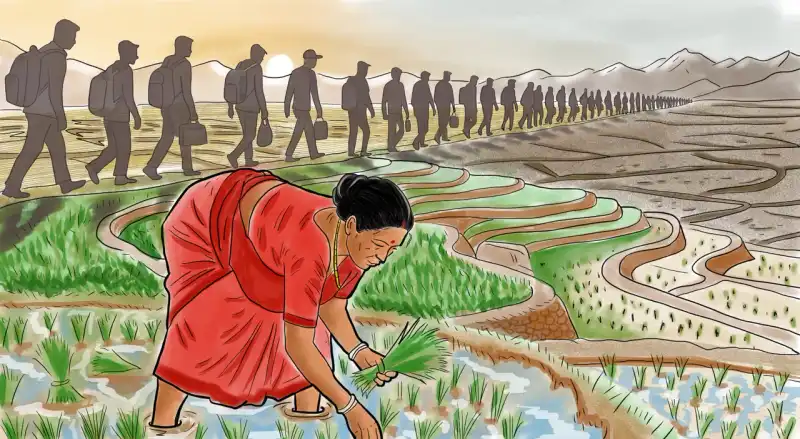
As men migrate for work, Nepal’s women are increasingly taking up agriculture – but society, policies and support systems are slow to catch up
In a small village in Raksirang, in the mid-hills of central Nepal, the trails wind upward along a slight hill. There, women sat in the sun, sorting vegetables and sharing news. Apart from the sound of their voices, the cluster of roughly 50 houses around them was eerily quiet.
Bishnu Maya Praja said that the wider area, on paper home to around 25,000 people, has almost “emptied out”. While the exodus began with men, women have recently started to follow. Her own husband left for Dubai two years ago to drive buses and has not returned since, the 26-year-old said. Her sister spent four years in Cyprus as a care worker for the elderly. Praja attributes this mass departure – replicated across Nepal – to the country’s dismal domestic job market. For most people, there is simply no other choice.
“Compared to 20 years ago, we now see women, who were primary workers in the family, now turning into primary farmers, a role that was previously held by men,” Rachana Upadhyaya, a researcher at the Southasia Institute of Advanced Studies and the University of Bristol, said. The Food and Agriculture Organization’s 2019 report indicates that more than 80 percent of women in Nepal work in agriculture. The number of female-headed households nearly doubled between 2012 and 2022.
According to a 2022 study on what is driving the “feminisation” of agriculture in Nepal, protracted conflict during the decade-long Maoist insurgency, which ended in 2006, as well as rising unemployment, has increased men’s out-migration, particularly from rural areas. This has led to a growing female labour force in agriculture. Yet as women are playing a more important role in decision-making, they face increasingly heavier workloads.
In central Nepal, while men work an average of 55 hours per week, women now can work up to 86.5 hours, managing both the household and the land. “That’s why, in our writing, we don’t say ‘feminisation of agriculture’, rather ‘feminisation of agriculture burden’,” Upadhyaya said. Over time, women have taken up more and more work both at the pre-crop and post-harvest stages. Yet the assets involved are very often controlled by men. The lack of machinery and transportation options available to women deepens what scholars call women’s “time poverty”.
“I have to do twice the amount of work,” 39-year-old Kumari Praja, who lives in a village not far from nearby Manahari, said. She used to farm three katha – roughly 1000 square metres – by herself. During harvest season, she wakes up at four in the morning, hoists sacks of grain or vegetables and treks an hour and a half to the nearest bus station. From there, she rides to a township to sell her produce. The most gruelling task in her farming routine is de-husking rice, still done entirely by hand.
Social taboos make the work harder. During field visits to nearly a hundred households, Bidhya Poudel Chettri, a researcher at the International Centre for Integrated Mountain Development, found that in many communities, cultural beliefs still forbid women from using oxen to plow. When the men are away, women must either hire male labour, increasing their financial burdens, or break the soil manually. The physical toil, Chettri noted, contributes to chronic back and joint problems, as well as reproductive health issues.
As millions of young and able-bodied men from Nepal have migrated abroad for work – to the Gulf states, South Korea and beyond – millions of women have remained behind. Many have turned to farming, sustaining the country’s agricultural lifeline. However, they still find themselves at the periphery of decision-making. Policymakers have yet to respond to the shift or introduce much-needed reforms that recognise Nepali women’s growing
role in the agricultural sector.
“I think the government and agriculture programmes have not come to the understanding that men are no longer the primary farmers of this country,” Upadhyaya said. “Women are.” Deeper reforms on land rights, labour policies, and gender-focused climate and agricultural programmes are vital to ensure that women can fully assume their place at the centre of Nepal’s food systems.
Climate change has already begun to impact harvests. Bishnu Maya rotates mustard, maize, rice and black beans on two katha of land, trying to keep it productive. But the earth is yielding less and less each year. Rainfall is erratic, arriving in violent bursts or failing altogether, forcing her to abandon weather-sensitive crops like tomatoes and chillies. Unfamiliar pests and giant snails now devour the dwindling harvest. She has to rely on chemical pesticides that her grandfather never used. Despite the increased labour, rising costs and lower yields have seen her monthly income plummet from NPR 20,000, around five or six years ago, to barely NPR 10,000 – or roughly USD 65.
Agriculture has historically been a major contributor to Nepal’s economy, and accounted for around 31 percent of the country’s GDP in 2013. In 2025, Nepal’s Economic Survey projected that agriculture would contribute just over 25 percent of economic output. And while almost 40 percent of Nepal’s workforce was employed in agriculture in 1991, that share has dropped to just over 22 percent in 2025 as low wages, unpredictability partly driven by climate change and a lack of economic opportunity pushed more people to migrate abroad in search of work. The number going through official channels exceeded 800,000 last year, with many more going via unofficial paths. Remittances now account for over a quarter of Nepal’s GDP, while the total amount of land under agricultural use has shrunk by roughly 300,000 hectares.
In some mid-hill districts, nearly half of cultivable plots have been left untended. Adding to this is growing competition from cheap imports. For indigenous communities like the Chepang, to which Bishnu Maya belongs, the impact is clear: once known for producing mustard, they now watch as Nepal imports increasing volumes of it from abroad.
Women bear the brunt in numerous ways. Besides their increasing labour and financial burdens, they are also more likely to die in disasters, partly due to the out-migration of men but also because they have less access to information. Around a decade ago, a landslide triggered by heavy rain ripped through Kumari’s home, forcing her and about 200 other households to relocate from the mountain where they lived to flatter land.
Yet the risks remain. Their new plots along the riverbank, allocated to Kumari and her neighbours for relocation, are under threat of rising waters. The narrow strips of land are shaded by towering trees that residents are not allowed to cut down under strict forestry laws. When storms roll in and the wind picks up, the fear of falling branches keeps families awake.
Early warning here is still largely a matter of intuition. Kumari and her neighbour read the clouds the way their parents taught them. But this ancestral knowledge is faltering. Winters are warmer and the timing of the rains has shifted. Maize that once took three months to mature now ripens in just two, resulting in smaller yields. In the Surkhet district of western Nepal, the monsoon has stretched from two months to four. The only path from Kumari’s new settlement to the nearby primary school crumbles a bit more with every rainy season, and a football-field-sized patch of land has already been swallowed by the river.
Amid this uncertainty, some are turning to their screens for answers. Leela Khadka is one of them. The surge in labour migration has brought smartphones to the most remote corners of Nepal. Often, the first thing a migrant worker does with their new earnings is to send a phone back home, or send home the money to buy one, to stay connected with relatives.
Leela uses her phone to talk to her husband and scroll through TikTok, but she also uses it to survive. Through GeoKrishi, a digital agricultural advisory platform, she checks weather forecasts and sends photos of strange fungi to agronomists who teach her what to spray and how to save her crop.
A few years ago, she became a local trainer through a government-initiated programme. She received training in digital and sustainable practices, and has shared that knowledge with other farmers. People like her also form a vital human chain of information in villages, knocking on doors or making mobile phone calls to inform people without smartphones of impending heavy rain or a severe drought.
Across Nepal, agricultural advisory apps like GeoKrishi, Smart Krishi, NARC Krishi and many more are gaining users. Researchers from the Southasia Institute for Advanced Studies (SIAS) in Kathmandu have noted a gradual uptick in their adoption.
Upadhyaya, who worked on the SIAS research, said she was struck “by how savvy the rural population of Nepal has become with new technologies.” She recalled a woman who uses video-calling apps to negotiate with vendors in the nearest town, take orders via social media and arrange deliveries without spending hours on buses.
However, the benefits of such digitally savvy agriculture remain unevenly distributed. Structural barriers such as illiteracy and limited smartphone ownership still keep the technology in the hands of relatively few. According to a survey conducted by SIAS, more than 45 percent of female respondents could not read or write, and less than half owned a smartphone. Only 3.5 percent were frequent users of agricultural apps; more than a third were entirely unaware they existed.
Many women struggle to navigate the apps. Gaumati Gharti, 45, found the small text on her screen a blur. While her husband has returned from India to start a modest organic farm and regularly does online research to help with cultivation, Gaumati struggles to tap into the same digital stream. The technical jargon in the app feels alien to her; even the term used for “humidity” differs from the word she uses in everyday speech.
“Facebook is all pictures, and TikTok is just scrolling,” she said with a laugh, describing how short videos and images make more sense to her than the text-heavy agricultural platforms. GeoKrishi now has over 200,000 registered users across Nepal. Language remains a primary barrier to uptake. Though most Nepalis understand the national language, many lack the confidence to use it in a technical context. Bikash Dangol, the Chief Financial Officer of GeoKrishi, noted that engagement in the eastern Terai region spikes when they hold sessions in the local Maithili language. But responses on the app are often AIgenerated, and much of the interface still operates primarily in standard Nepali, leaving those who speak regional tongues – of which Nepal has over a hundred – on the margins.
Digital agriculture is a new aid, but it remains deeply shaped by existing social systems. Inside homes, power dynamics further determine who actually benefits. In many cash-strapped households, smartphones are effectively owned by the father-in-law, husband or eldest son. A woman may only be allowed to use it late at night, after others have gone to bed.
A similar pattern appears around money. In the all-female cooperatives that GeoKrishi works with, women discuss seeds, fertilisers and market prices. They sit together to listen to audio tips from experts. But when it comes to taking action, such as purchasing a new seed variety or changing fertiliser use, the final word often belongs to someone who is not in the room. “I have to ask the men of the house first,” women say repeatedly.
For the single and widowed women the Tukee Foundation works with, the lack of land titles poses a greater barrier than the lack of a 5G signal. In Nepal, land and houses are still predominantly owned by men. Historically, Nepal’s first legal code, the Muluki Ain, permitted daughters and widows to inherit property only under narrow conditions, which reinforced the practice of passing on ancestral land only through the male line. Although reforms, culminating in amendments in 2002 and a new 2017 Civil Code, now give equal inheritance rights to daughters and sons, many families still prioritise sons when it comes to land ownership due to social resistance and weak enforcement. As of 2025, men accounted for 61 percent of all land registrations, with women still firmly in the minority despite a discount on registration fees.
Without land in their own names, women remain “invisible farmers”, ineligible for many government subsidies, formal bank loans or digital insurance products. Tukee’s executive director, Sheela Sen Thakuri, said this invisibility also shapes psychology. If a woman does not legally own the land she farms, she is more hesitant to invest in long term needs such as tools and infrastructure.
Even when local governments offer seemingly generous support programmes, such as 50-percent subsidies for agricultural machinery, the remaining cost can be overwhelming for marginalised women. In practice, well-connected male farmers and local elites are more likely to benefit from these incentives.
Research published in 2025 in Frontiers in Sustainable Food Systems suggests that male farmers in Nepal are still the default beneficiaries of extension services and credit institutions. A lack of financial guarantees makes women more risk-averse. In times of severe drought, Upadhyaya noted, men are also more likely to secure pump or tap subsidies, while women are often left without resources and remain especially vulnerable as climate impacts intensify.
For Upadhyaya, digital transformation is an opportunity that could go either way. “Due to the design of mobile phones, you don’t actually have to be literate to use TikTok or Facebook. That can open up real possibilities and alternatives for women farmers,” she said. “Or, it can simply reproduce the gender differences we already have in the real world within the digital world.”
But none of this can substitute for deeper reforms: secure land rights, fairer labour policies, improved affordability and access to technology, and climate and agricultural programmes that treat women as central actors in Nepal’s food system.
In recent years, increasing numbers of migrant workers have been returning to Nepal due to life-threatening working conditions and the impact of the Covid-19 pandemic. Many have expressed an interest in reintegrating through agricultural work. This has made bridging both gender and digital divides particularly urgent. Otherwise, as men return to the land, women who kept farms alive through years of hardship and uncertainty might be pushed once again into the shadows.
This story was produced with the support of Asia Pacific Forum on Women, Law and Development’s Media Fellowship on Digitalisation and Feminist Digital Rights and Justice.
Anita Zhang is an independent journalist dedicated to exploring the ethical frontiers of technology. Her reporting investigates social equity and climate change mitigation strategies shaping South and East Asia.