"How can a democratic government do something like this?” asked Shivmuni Singh, aged 74, with visible bewilderment. His two-day journey from a village in Buxar district, in the eastern state of Bihar, which included spending a night in a railway station on the outskirts of Delhi, culminated at barricades that had come up around the centre of the capital city. He was some 2.5 kilometres from Jantar Mantar, an 18th-century astronomical observatory and an officially designated protest site. There were at least 200 policemen at the barricade where he had been stopped.
On 10 October, the Cockroach Janata Party (CJP), the youth-led movement aiming to hold India’s government accountable to its people, which began this summer and has gathered enormous momentum since, called for a protest in Delhi against Gyanesh Kumar, the Chief Election Commissioner, who has been accused of illegality in implementing of a Special Intensive Revision (SIR) of electoral rolls – an exercise that many allege is being used to target minority communities and opposition voters. The SIR has already removed 130 million voters from the rolls, and opposition parties in several states say the process has helped Narendra Modi’s Bharatiya Janata Party (BJP) win recent elections.
Singh had first seen videos put out online by the CJP’s founder, Abhijit Dipke, a 30-year-old Dalit graduate, during the student protests that the movement spearheaded against examination paper leaks in July. Those massive protests had captured the imagination of many Gen-Zs, and led to the resignation of Modi’s education minister – only the second resignation from Modi’s cabinet in the 12 years since he took power, and a rare showing of susceptibility by India’s BJP government.
“The moment Dipke said youth will protest for our right to have fair elections, I wanted to come in support,” Singh said when I met him on 10 October. “My father was a freedom fighter who went to jail when fighting for independence. So, speaking up for issues of the country runs in our blood.” He was among the handful of protestors who had managed to circumvent multiple layers of barricades and enter the administrative heart of the capital.
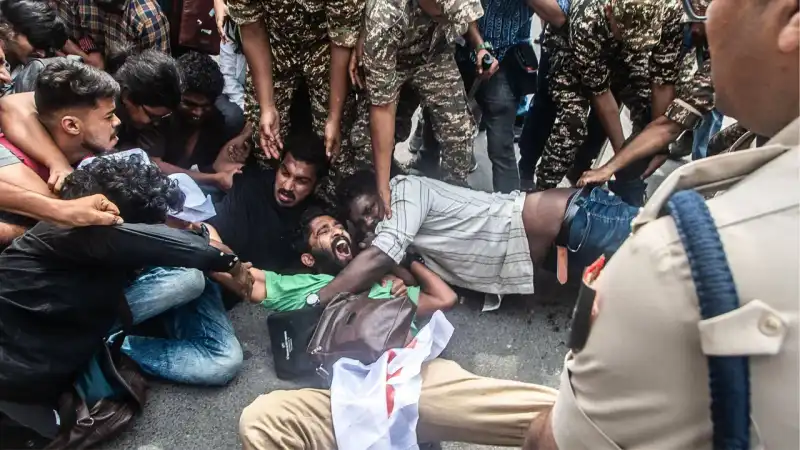
As we talked, a surveillance drone hovered above us. Every so often, a troop of police would spring into action, blowing loud whistles, beating their sticks on the road and frantically chasing students who had managed to sneak past prior layers of the cordon. Each time the police approached Singh, he raised his hands in a plea to be left alone, and they softened in deference to his age. Other protestors were not as lucky. Many were dragged and shoved into public buses stationed nearby to take protestors to a detention centre. “I don’t remember much of the Emergency,” Singh said, referring to the period between 1975 and 1977 when Indira Gandhi, as the prime minister, had suspended fundamental rights. “But I would imagine it was something like this.”
Many have been drawing parallels between the Modi government’s reaction to the CJP protests and Indira Gandhi’s Emergency. Not for the first time, in light of Modi’s many assaults on dissent and democracy since 2014, his rule is being described as an undeclared Emergency. Even so, the events in Delhi on 10 October, with a massive security operation against the protestors that showed naked disregard for democratic rights, marked a serious escalation in the public mind. This was Modi’s Emergency moving up a gear, and the comparison to Indira Gandhi’s effort, once the preserve of academic analysts and political pundits, is now self-evident to ordinary citizens like Singh.
A day before the planned protest, the Supreme Court of India had asked if the government’s restrictions were akin to using a “hammer to kill a fly”. Some 23,000 security personnel, including those having served in anti-terror operations in India-administered Kashmir and in operations against leftwing insurgents, were deputed to be in Delhi. Internet services were shut across a four-square-kilometer radius, covering a region of the capital that includes the home of the prime minister, the embassies of most major countries and the Supreme Court. Fifty-seven metro stations – a fifth of the stations in a system that transports more than six million people daily – were closed by government order. Almost 250 trains to India’s busiest railway stations were cancelled.
Thousands of people were detained preemptively, including from the protest site at Jantar Mantar. Barricades erected on almost every road in central Delhi turned it into a ghost town – the silence only punctuated by loudspeakers blaring warnings against gatherings, protests or processions, and the frenzied sirens of open-top vehicles carrying armed policemen. On the same day, a group of eminent citizens wrote to Delhi’s police commissioner pointing to the police force’s misuse of the law to impose restrictions and carry out preventive detentions. It said that “dissuading citizens from exercising their democratic choice and fundamental right to demonstrate and assemble peaceably to voice their demands is criminal intimidation, especially when carried out by the constabulary. It amounts to a threat of dire action if the people fail to heed these words.”
On 10 October, more than 7000 people were detained by sunset. The list includes former chief ministers from opposition parties, lawyers who intended to march from the Supreme Court, and journalists on their way to simply do their jobs by covering the protests. Dipke and other leaders of the CJP were detained by police right from inside the commercial flight on which they landed in Delhi. Students trying to head to the capital from other parts of India were detained at railway stations hundreds of kilometres from Delhi. In Muslim-dominated areas of the south of Delhi, which have a history of protests against the Modi government, students were detained through the preceding night. This was all a direct expression of the Modi government’s will: the capital’s police answer directly to the central government under him.
But the Modi administration’s disproportionate action against citizens asking for accountability also illustrates its panic, and what it has at stake. The BJP’s stranglehold on political power in Delhi and across the largest part of India in the last 12 years has been built on an image of Modi as a strong leader with almost divine qualities, whose wisdom should be unquestioned. The July protests, filled with memes and mockery of Modi and his government, made deep dents in that image in ways that other antigovernment protests over the past decade never managed to do. The government revealed that it did not know how to counter public derision, and it does not seem ready for a second round. More importantly, this time around, India’s citizens are asking questions about the very legitimacy of the Modi government. And the protestors, though thwarted on 10 October, remain undeterred.
There is a Kafkaesque element to the story of the CJP, both in the government’s response to it and in the movement’s choice of name. The CJP started out as a parody Instagram account in May after the Chief Justice of India likened unemployed youngsters to cockroaches. Modi’s concession to the CJP with the resignation of the education minister in July amounted to an admission of misgovernance – and, especially in the minds of young protestors, it ripped away the notion of his invincibility. The prime minister would have hoped the resignation would be enough to defuse the movement, but it only emboldened it. Now, the BJP government faces an even tougher choice as the CJP demands the removal of Gyanesh Kumar. One resignation could be seen as just an aberration for a regime otherwise thought to be in complete control; two would come dangerously close to an invitation for holding the whole of the ruling regime accountable.
The Chief Election Commissioner is constitutionally an independent officer, not associated with any political party, whose authority is meant to supersede that of the government in power. Gyanesh Kumar attained the post, at the head of the Election Commission (EC), after the Modi government changed the law to remove the Chief Justice of India from the three-member panel – including the prime minister and the leader of theopposition – that selects election commissioners. Instead, the third panel position was given to a cabinet minister nominated by the prime minister, giving the incumbent government the majority to push through its preferences – and delivering a telling sign that the independence of the position might be compromised.
In a recent interview, a journalist with the television channel Aaj Tak – part of the notorious “Godi media” seen as being lapdogs of the BJP – asked a potential political ally of the BJP in the state of Punjab about the recent protests. The ally said that Gyanesh Kumar should resign, to which the reporter shot back by asking why he would want to ally with the BJP if he thinks so. “I call for his resignation because it is a serious allegation against him,” the Punjab politician responded. “But you seem to be implying that Gyanesh Kumar and the BJP are linked? That the EC is the BJP and the BJP is the EC?”
It is evident that the election chief’s resignation would reflect directly on Modi and the BJP, and how they have undermined democratic processes and institutions. It would be a tacit admission of wrong-doing, and uncomfortable questions would dominate airways: Did India not have free and fair elections in recent years? Has the BJP come to power in many of India’s states only through fraud? Was the opposition right in its claims that it was being systematically robbed of votes?
For Modi, it is a difficult situation that can only be held at bay through internet shutdowns, through deploying tens of thousands of security personnel, and through hoping that the protests fizzle out and the memories of them fade. But it all seems futile if the choir of dissenting voices spreads, as it has already done, beyond the cordoned-off protest site.
On 10 October, Vicky Kumar managed to reach Connaught Place, a commercial centre just 300 metres from Jantar Mantar. Usually bustling, on this day it was uncharacteristically quiet, having been cut off from the rest of Delhi. Vicky was wearing a shirt with an image of Netaji Subash Chandra Bose, a radical freedom fighter whose legacy the BJP is trying to appropriate. The internet shutdown had prevented him from communicating with his friends, who were detained on their way to the protest site from the west of Delhi. “I’m disappointed that I couldn’t help my friends,” he said. “I could have shown them a way through the narrow gullies so that they could have avoided the checkposts.”
Sansad Marg and Janpath, the main roads that lead to Jantar Mantar, were blocked off completely by a wall of policemen standing shoulder-toshoulder. Vicky bravely held up a placard that read: “Illegal elections are taking place in the country. Modi is an illegal Prime Minister.” He told me he is 28 years old, and preparing for competitive examinations. “The mistake I’ve made is to have voted for the BJP in the previous elections,” he said. “I want to ensure no one else makes the mistake. Deleting 13 crore [130 million] names from the voter list is unjustifiable.” Vicky was soon picked up by the police, along with other protestors. Almost every half hour, like some rehearsed routine, the police would don their helmets and fibre-glass shields, and run through the gathering crowd to detain young protesters. The protestors would disperse into the lanes of the eerily empty commercial centre: some in glee for outrunning burly policemen, some continuing to take videos of the run, some in fear after nearly being caught. Those caught were put in buses that drove them out of central Delhi.
The protests in July, also held at Jantar Mantar, were initially small. But as it stretched on over weeks, speeches made at the site went viral, as did the banners, placards and hoardings that adorned it. Police brutality when they cracked down on the students on 20 July was vividly captured in 4K video and livestreamed. This only drew more young people to the protests, who deployed the tools and language of their generation – their messages were profane, irreverent and openly mocked Modi, and spread uncontrollably online. The leader who had held an authoritarian grip over the narrative and masterfully curated his online presence suddenly became cringe-worthy and uncool. The government’s efforts on social media to assuage the jeering youth backfired. Modi started posting short video reels to directly address Gen Z and his ministers came out to support him – some cajoling the students, some scolding – but they were all met with disbelief and ridicule. The internet curfews in central Delhi and the detentions ensured that 10 October could not trigger the same series of reactions that 20 July did. Jantar Mantar was far from the festive protest site it was three months ago.
“I’m a little disappointed actually,” Rocky, who asked to be referred to by just one name, said. “I thought there will be so many people, maybe I’ll get beaten or I’ll get to see what tear gas looks like.” The 22-year-old had travelled for two days from Durgapur district, in West Bengal. In that state, more than nine million names were deleted from the voter rolls earlier in 2026, leading to allegations that these exclusions had led to the BJP storming to power there for the first time. Many of Rocky’s friends and relatives could not vote. Though he had spent the day in Connaught Place in vain, he vowed to remain in the city in case the protests restarted. A day before the protests, the Delhi police issued a press release detailing the “rationale” of the restrictions. Permission to gather and protest had been denied to the CJP because of the experience of the last protests, it said. The government had told the Supreme Court the same thing to justify the draconian measures in central Delhi.
The Delhi police posted a video on X showing the sparse instances of violence by protestors during the previous protests, which had been overwhelmingly peaceful. The video conveniently ignored the police’s liberal use of beatings, detentions, tear gas and pellet guns. While all the cases lodged against CJP protestors were withdrawn in July, following a detente with the government after the education minister’s resignation, the Supreme Court is monitoring a probe regarding police excesses and the harassment of female protesters at that time.
The government has another mechanism to intimidate protestors, in the form of its support base and BJP cadre, as well as the many people and organisations affiliated with the Hindu Right. “I have come here to say we support the Delhi police,” Ravindra Singh, alias Govinda Hindu, said when I met him in central Delhi on 10 October. “These traitors do not have permission to protest.” He claimed not to be affiliated to any organisation but used buzzwords often uttered by the BJP. “First, they wanted the resignation of the education minister. Now, they want the Election Commission. Next, they will want our prime minister to resign.” He was among the many groups of right-wing counter-protestors who had gathered in Connaught Place. By and large, they were not detained, even though they spent the day in groups, raising slogans. The police had invoked provisions of the penal code that prohibited civilian gatherings of any kind in the area.
Through the day, with the police in mute observance, the men – and one woman, who wore a “Smash the Cockroaches” t-shirt, presumably a counterreference to opposition leader Rahul Gandhi’s recent rallying cry of “Smash the Patriarchy” – harangued the posse of hundreds of journalists and content creators in attendance. “Traitors”, “anti-national”, “leftists” and “anti-Hindu” were often shouted out.
Ravindra talked about the CJP supposedly wanting to unleash anarchy, drawing parallels to the revolutions that have toppled ruling regimes in Nepal and Bangladesh in recent years. This parroted the social media posts by the BJP to discredit the protests and justify their suppression. Moments after he spoke to me, Ravindra and his associates were videographed assaulting protestors – dragging them by their collars, shoving them to the ground and repeatedly punching some young people – while the police looked on. It was only after the videos gathered millions of views online that, late in the evening, the four men involved in the attack were arrested.
At this moment, there are few takers for the right-wing’s rhetoric, online and offline, and the BJP seems to be aware of its declining influence among the chronically-online generation. Between 2014 and 2018, terms like “urban naxals”, “tukde-tukde gang” and “andolan jeevis” – derogatory terms for those on the left and anyone who dared question the government – found their way into the lexicon of everyday political talk, with no little help from Modi himself. The opposition spent much time and energy simply deflecting and defending against the pejoratives, and remained on the defensive. But in mid-2026, when Modi tried to label people criticising him “dimagi naxals” – people with the mentality of left-wing extremists – it failed to excite right-wing imaginations or intimidate his targets. Instead, the term has become a badge of honour for many Gen Z protestors.
Worse still for the BJP, the earlier wave of CJP protests, and the online chatter after them, has given ample space, views, likes and comments to a vocal new generation on the left. Between 2014 and 2026, the Left in India saw a rapid decline. Today, for the first time in nearly 50 years, no Left government is in power in any Indian state. There are just eight legislators from the Left in the country’s parliament. But one of the most charismatic faces of the CJP protests now is Neha Bora, a leader with the All India Students’ Association, the student wing of the Communist Party of India (Marxist–Leninist) Liberation. As with many Left leaders, she is unabashedly direct and vocal – and this language is now finding currency in the digital space. Calling Modi a fascist has been a feature of the speeches at the protests.
At some point on Saturday afternoon, the evidently right-wing group of counter-protestors in Connaught Place spotted two Muslim women, one wearing a hijab, as they talked to journalists and content creators. They surrounded the pair, heckling them and even claiming that the CJP protests were “60 percent these people”. “I didn’t feel scared at all,” one of the women later told me, despite the intimidation and the apparent danger to her and her friend. “Their Hindu- Muslim talk is boring and stale.” This was a sharp departure from recent years, when the Hindu Right has wielded Islamophobia as a terrifying and effective weapon. She had dodged multiple barricades to come to Connaught Place. “I came here despite the fear of arrest because I have a two-year-old son at home. I need to speak up now for his future.”
On 11 October, Modi posted an homage to the socialist leader Jayaprakash Narayan on his birth anniversary. Narayan was known especially for his opposition to Indira Gandhi, and was jailed by the Delhi police during the Emergency. “His fearless voice during the Emergency was also noteworthy,” Modi wrote. A majority of the comments under his post pointed out the dripping irony, another instance of the narrative slipping out of Modi’s hands. The very same day, the Supreme Court issued notices to the central government, the Delhi police and the Delhi Metro Rail Corporation seeking responses as to why they should not be held in contempt for violating the court’s orders against complete restrictions on public transport. The court also heard petitions from lawyers brutalised during the protests, and ordered the restoration of internet and metro services.
All across Delhi, myriad small and some big protests continued over the weekend and on Monday. The opposition conducted its own marches and student groups, particularly from the Left, found a way to stage protests at Connaught Place. On 12 October, after the CJP met the police to seek formal permissions and a date for a fresh protest, the Delhi Police de-notified Jantar Mantar as a protest site. Instead, the three new protest sites were designated, all outside central Delhi and far from the corridors of power.
For Shivmuni Singh, it was all too late. He headed back to Bihar on the train after being detained by the police. “But we are following everything on YouTube,” he said over the phone. “We are seeing all the videos of the gundagiri” – the hooliganism – “of the police.” Singh planned to “come back soon for the protests, and with many more people the next time.”
Mohit M Rao is an independent journalist based out of Delhi. He writes on human rights, law and the environment.