Labor
Bodies for Export: Blood Cherries
Behind Chile's glossy agro-export success lies a system of structural precariousness that exploits thousands of migrant women.
In contemporary Chile, anti-migrant rhetoric has gained ground through promises of order and security, obscuring the reality that various sectors of the economy—particularly agro-export—structurally depend on the precarious labor of thousands of migrants, especially women, whose bodies are turned into disposable cogs in a system that celebrates its macroeconomic figures, while producing extremely poor conditions for a considerable percentage of its inhabitants.
The conditions of informal employment and violence faced by these workers reflect a systematic pattern of rights violations, sustained by a scapegoating logic that blames migrants for structural crises, thereby blocking discussions that would allow for questioning the conditions underlying the crises currently being experienced in the country.
This critical analysis article presents and discusses some of the main findings of a study conducted in the O’Higgins Region of Chile, whose initial objective was to document the working conditions of migrant workers in the agricultural sector, particularly in the fruit export industry.
The study reveals the systematic precariousness of migrant labor, as well as civil society’s limited awareness of working conditions in this sector. This article proposes a critical analysis from a human rights, gender, and intercultural perspective, examining the economic, political, and cultural structures that enable the precariousness of migrant labor, as well as the narratives that legitimize the exclusion and silencing of those who, from subalternized positions, sustain the Chilean agro-export model.
As context, it must be considered that the Chilean countryside has historically been a space for the extraction of value and the reproduction of inequalities. In particular, in recent decades the agro-export model has deepened this logic, relying on temporary and migrant labor, instrumentalizing irregularity as a status that enables an even more precarious labor structure, without even the support of minimum labor rights guarantees.
It is particularly cruel to note that, despite its centrality to the prosperity of the national economy, the conditions under which work in this sector takes place remain invisible in public debate and even more neglected in the realm of state governance.
The findings of this research are unequivocal and reveal a reality that cannot be ignored. Migrant agricultural work in Chile takes place under conditions of structural precariousness that demonstrate an intentional violation of rights.
From the absence of formal contracts during periods of high demand, the non-payment of overtime, and the substitution of work hours with irregular pay slips, to overcrowding in accommodations that lack minimum habitability standards—where there are no designated spaces for eating, resting, or storing belongings—the picture is bleak.
Added to this are the lack of effective oversight by labor institutions, discrimination and violence against migrant women, as well as prolonged exposure to pesticides without minimum safety protocols.
Far from being isolated exceptions, these practices reflect a widespread pattern within the Chilean agricultural production model, whose extractive logic is sustained, in an almost structural way, by the legal and social vulnerability of the migrant population. A profound critique of the system and concrete actions to guarantee dignity and justice in the Chilean countryside are therefore urgently needed.
This is a phenomenon that is repeated in various countries and continents, and is closely intertwined with the rise of far-right political movements and their use of anti-migrant rhetoric, in which migrants are portrayed as a threat to security, employment, and national identity.
We therefore see an abusive and biased practice of unequally distributing precariousness and the risks of certain types of work being masked by rhetorical justifications that create a threshold of acceptability for these conditions among a population that becomes a scapegoat for the crises inherent in the capitalist model.
This is disturbingly similar to what occurred during colonization, with the construction of race and, in parallel, the enslavement of certain people who are discursively portrayed as prone to extreme working conditions.
In contemporary practice, what was imposed during colonization is perpetuated through globalization, creating a cycle of forced displacement due to the expropriation of land for the exploitation of its material resources by transnational corporations from the Global North, and in turn, the production of migrants who embark on a migratory journey driven by desperation, amid conditions of impoverishment that create the perfect breeding ground for them to be coerced into accepting extremely poor working conditions, paid at rates that are extremely low compared to the national standards of the countries they arrive in.
In the United States, the phenomenon gained enormous visibility during the administrations of Donald Trump, and its logic finds disturbing parallels in the Chilean context. The rhetoric of the border wall, mass raids, accelerated deportations, and the separation of migrant families doubles down on the old restrictive immigration policy, succeeding in more broadly establishing the idea of a common enemy of developed and developing economies alike.
Under this narrative, migrants become a symbol of insecurity, crime, and social disorder, allowing economic and structural frustrations—such as inequality, job insecurity, or the concentration of wealth—to be channeled toward a vulnerable group, thereby diverting attention from the true causes of social unrest.
The paradox is that both the U.S. and Chilean economies continue to depend heavily on migrant labor, since agriculture, construction, services, and domestic work function thanks to millions of migrant workers, many of them in precarious conditions, making irregular migration indispensable to the current economic system.
Therefore, it is argued that this contradiction is not accidental, as it constitutes a central mechanism allowing neoliberal countries to continue their accumulation and profit-driven approach, saving the cost of this production rhythm at the expense of subordinated people.
On the other hand, the security-oriented approach emanating from authoritarian government projects strengthens their political legitimacy through the persecution and dehumanization of these people. In this sense, the work of those who research or highlight these issues is to denounce these perverse mechanisms, in order to advocate, instead, for a migration policy based on rights and dignity.
In recent years, the public debate on migration has increasingly been dominated by discourses that directly link it to rising crime and the intensification of the social crisis. The complexity of the migration phenomenon has been replaced by simplistic narratives that portray migrants as responsible for problems with much deeper and historical roots.
The current government represents the institutional consolidation of this political shift through the implementation of deportation policies, the—supposed—strengthening of border controls, the increase in immigration raids, and the construction of a narrative centered on the “restoration of order,” all of which form part of a strategy aimed at responding to the demands of conservative sectors that have made migration one of their main mobilization issues.
These policies generate an effect that rarely appears in public debate: the increased vulnerability of those working in the most precarious sectors of the economy.
Irregular status, which is produced by restrictive immigration policies, complex bureaucratic processes, difficult-to-meet requirements, and legal frameworks that limit access to regularization, is put at the service of the global economy and, in turn, reinforces the justification for social control over the entire working class of the country.
However, due to their position in the nationalist hierarchy, migrants face greater difficulties in reporting labor abuses, accessing public services, organizing into unions, or demanding better working conditions.
In other words, the loss of immigration rights quickly translates into a loss of labor rights, and it is precisely here that the case of migrant seasonal workers and the agribusiness sector takes on greater relevance.
The research documented how women from Haiti, Venezuela, Bolivia, Colombia, and other countries in the Global South work in agribusiness under conditions of extreme vulnerability, marked by informality, long working hours, and the absence of labor protections.
Furthermore, when the fear of deportation becomes an ever-present threat, the possibilities for resistance diminish, turning deportation into a disciplinary threat that permeates daily life.
It is worth noting that anti-migrant rhetoric intensifies in times of economic uncertainty. When inflation, unemployment, or social insecurity rise, the far right offers an extremely simple explanation: blame those who came from outside. Historically, this scapegoating mechanism has been used time and again in multiple contexts to shift responsibility from economic elites onto socially vulnerable groups.
The housing crisis, for instance, is transformed—thanks to the power of narratives—into a migrant problem, just like the strain on public services or insecurity. In this way, the structural causes linked to decades of privatization, inequality, and the erosion of social rights are obscured.
Xenophobia thus functions as a deeply effective political tool that fragments the working class, pitting Chileans against migrants who, in reality, share increasingly precarious and similar working conditions. However, rather than questioning the structures that produce this precariousness, far-right discourses promote competition among the workers themselves, diverting any potential collective struggle.
In response, a critical stance must insist that the real conflict is not between nationals and foreigners, but between those who sustain the system with their labor and those who benefit from their division.
Furthermore, due to the intersection of various categories of subordination, the consequences of these policies do not affect everyone equally, producing a system of domination where migrant women occupy a particularly vulnerable position as they face, simultaneously and cumulatively, inequalities of gender, class, race, and immigration status.
In Chilean agribusiness, this intersection of oppressions manifests in lower wages, higher levels of informality, constant exposure to workplace and sexual violence, and an enormous, unrecognized burden of care work, which in turn exposes the children of these workers to extremely precarious living conditions.
Turning to another aspect of this phenomenon—specifically regarding the global rise of the far right—we must recognize that the object of domination is always expansive, and that what initially appears to target foreign nationals most prominently quickly begins to affect the domestic population as well.
The same sectors that promote anti-immigrant policies also challenge women’s rights, labor rights, social movements, unions, and human rights organizations. The construction of the migrant enemy is not an end in itself, but rather part of a broader logic of democratic rollback.
Therefore, the fundamental question behind the advance of these policies is not how many migrants enter or leave a country. The truly relevant question is what kind of society we want to build. Is it part of our collective aspiration to live in a society that normalizes exploitation when it affects racialized and foreign bodies, or in a society that transforms fear into a political agenda?
This essay seeks to contribute to the construction of a collective project capable of recognizing that human rights do not depend on nationality, that dignity in the workplace cannot be conditioned by an immigration permit, and that migrants do not constitute a threat, but rather a fundamental part of the economic, social, and cultural life of our territories.
The migrant women who harvest cherries for export reflect how contemporary economies continue to depend on forms of labor whose precariousness is rendered invisible to ensure their unpunished reproduction. In this way, what is at stake today is not only immigration policy, but the very meaning of democracy, equality, and rights.
Irregular agricultural work, especially among the migrant population, constitutes one of the most persistent and silenced forms of exclusion in contemporary Chile. However, what is truly alarming is the deep social and institutional normalization of these conditions, which entrenches the idea that the systematic violation of rights is a natural and inevitable cost of the agro-export model.
In the face of this structural indifference, it is urgent to move toward an agenda of profound transformation. First and foremost, public policies are needed with a genuine focus on human rights and social justice, placing the dignity of those who work the land at the center. It is also essential to recognize the fundamental role that migrants have historically played in the Chilean economy, a role that has been systematically rendered invisible by xenophobic discourse.
This must be complemented by critical education on the agro-export model and its social, environmental, and labor impacts, dismantling the false neutrality of an industry that boasts of its export figures while sustaining its profitability on the backs of precarious workers.
Finally, transformation will only be possible from the bottom up, by promoting community, union, and regional networks that organize, support, and dignify agricultural work, restoring agency to those who have been reduced to mere instruments of production.
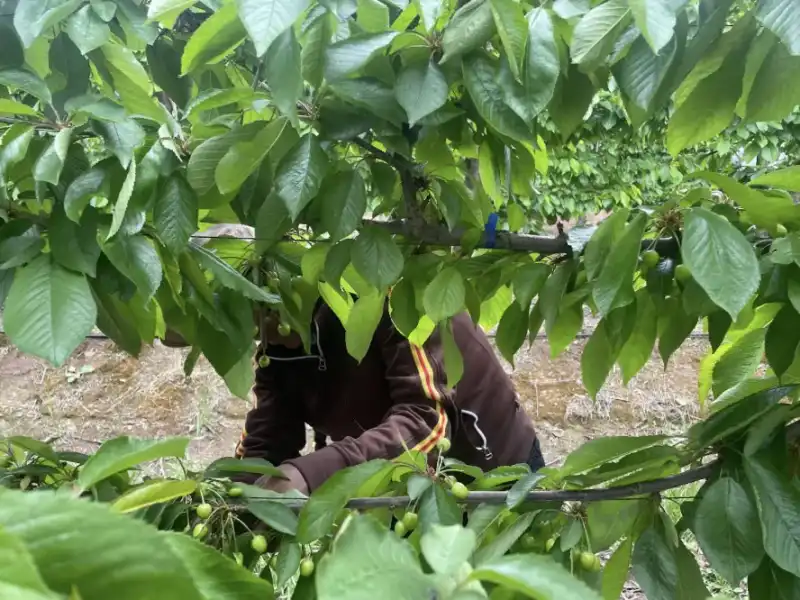
The Chilean cherry is a metaphor for an economy that shines outwardly while hiding its roots in vulnerability. It shines in international supermarkets, fuels export figures, and sustains the narrative of a modern, competitive country open to the global market. However, behind that image lie invisible bodies: migrant, seasonal, and racialized women, often without contracts, without social protection, and exposed to grueling workdays in the fields.
Under the government of José Antonio Kast, this reality has become even more severe. His administration has promoted a policy of tightening immigration controls, with deportation flights, stricter border controls, and measures aimed at increasing the removal of undocumented migrants. The government itself announced, in April 2026, the formal launch of a permanent policy of deportations via air and land operations.
The National Migration Service noted in May 2026 that 630 deportations had already taken place that year, also highlighting the increase in operations compared to the previous period. Added to this is the so-called “Return Plan,” presented as a voluntary departure mechanism for undocumented migrants.
However, the underlying problem is political, since while the state tightens immigration controls, the market continues to need that same labor force to sustain agricultural production. Those who cross borders are criminalized, yet working without a contract is tolerated. There is talk of order, but companies that benefit from informality are not regulated with the same intensity. Migrants are targeted, not the employers who exploit them.
In the fields of O’Higgins, the investigation found that more than 90% of the female workers interviewed did not have a formal contract, leaving them excluded from labor rights, social security, and effective complaint mechanisms. This lack of protection is exacerbated in the case of Haitian women, for whom the language barrier limits access to information about rights, contracts, and complaint channels, creating greater dependence on contractors and intermediaries.
Anti-migrant policies do not resolve precariousness; rather, they systematically exacerbate it.
By increasing fear, the threat of deportation, and legal uncertainty, they push migrants into even more informal, clandestine, and exploitative labor circuits. Instead of guaranteeing rights, they produce greater levels of vulnerability; and instead of confronting the agricultural business sector that sustains its profitability through labor exploitation, they shift all responsibility onto those who already occupy the weakest link in the production chain.
The contradiction is evident and morally unsustainable, since the very country that expels migrants needs their hands to harvest, sort, and pack the fruit it exports to the world. The border closes to rights but opens to exploitation. That is why discussing migration in Chile cannot be reduced to security rhetoric or the demagoguery of order. We must keep asking the question: who are the main beneficiaries of the production of irregular migration?
The Chilean cherry, as an emblem of agro-export success, thus becomes a brutal metaphor for the present. It is brilliant, successful, and profitable abroad, but its existence is sustained by bodies that are precarious, racialized, and disposable at home.
In the face of institutional racism and migratory authoritarianism advancing under the guise of “order,” it is urgent to clearly establish a class-based, feminist, and anti-racist policy that unequivocally defends mass immigration regularization, effective oversight and sanctions against employers, the right to decent work, and the autonomous organization of migrant workers.
There can be no sovereignty built on the basis of bodies that can be expelled. Nor can there be social justice as long as Chile’s export success continues to rest on undocumented migrant women, reduced to mere bodies for export.