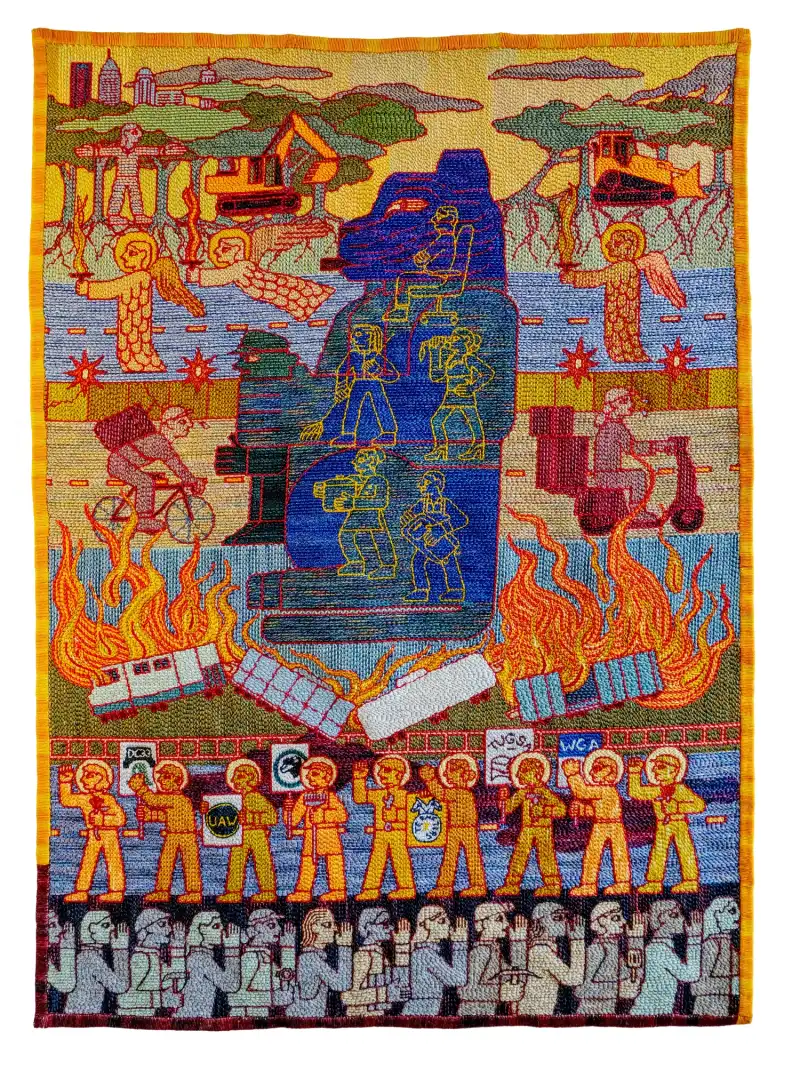
Briefing
PI Briefing | No. 23 | The Earth Beneath Us
The fires are here. So are the technologies of transition. What is missing is power over investment.
Austrians are used to August temperatures in the mid 20s. This week, the thermometer breached 41 degrees. Climate breakdown is here: the geological ground on which humanity sits. Europe’s summer image has shifted from holidaymakers enjoying ice cream to firefighters holding back walls of flame from nuclear power stations.
Across Europe, the heat has emptied rivers, hurried harvests and throttled power stations. The Danube has fallen to record lows — just four inches on the Budapest gauge this week — forcing fuel barges farther downstream to carry just 30 to 40 per cent of normal loads. Repeated heatwaves cut short the grain-filling season, bringing the harvest forward and reducing projected yields. In France, rivers grew too warm to cool eight reactors, cutting nuclear output by 6.3 gigawatts. Fires have consumed more than 90,000 hectares in France and 200,000 in Spain. Drought has been declared in half of England, where the wholesale price of tomatoes is up by more than 60%, lettuce by 90% and potatoes by more than 40%. August has only just begun.
The disruption reaches far beyond Europe. El Niño is strengthening rapidly in the Pacific. The US National Oceanic and Atmospheric Administration gives it an 81 per cent chance of becoming “very strong” — its highest category — between October and December. The World Food Programme estimates this El Niño could push at least 49 million more people into acute food insecurity by the end of next year. Cereal prices are already 6.9 per cent above last year, according to Food and Agriculture Organization figures released today.
We cannot bring the old climate back. But we are not helpless. Humanity already knows how to produce energy without burning coal, oil and gas. China has built wind and solar power on a scale without precedent. Its emissions remain below the high reached in early 2024, and coal supplied less than half its electricity in the first six months of this year. The state set targets, directed credit and organised factories, grids and supply chains, investing $625 billion in clean energy in 2024. Emissions intensity fell 12 per cent from 2020 to 2025, still short of the planned 18 per cent. China has built the machinery of transition; it is only beginning to turn it against fossil power.
No other country combines China’s economic scale with the same capacity to direct investment. Left to the market, each new energy source has been laid over those before it. Coal survived oil. Oil survived gas. Renewables have risen alongside fossil consumption. In 1865, English economist William Stanley Jevons saw that greater efficiency could lower costs, open new uses and increase total demand. Without a decision to close mines and wells, cheap clean power feeds new production while fossil fuels keep burning.
Profit pulls the other way. When the US-Israeli war on Iran sent oil prices soaring, eight major oil companies made $93 billion in three months. BP more than doubled its quarterly profit while retreating from low-carbon investment; Shell sold its European onshore renewables business this week. The market does not close a profitable oilfield because a solar panel is cheaper. It keeps both.
At the centre of this order, with its carrier groups and export terminals, stands the United States. It produced more oil in 2025 than any country in history and supplied more than a quarter of global LNG exports. But American fossil power extends far beyond its own wells. In January, US forces kidnapped President Nicolás Maduro and Washington took control of Venezuelan oil sales and revenues and redirected cargoes towards US refineries. In the Gulf, the US-Israeli war on Iran effectively closed the Strait of Hormuz, through which around a fifth of the world’s oil and LNG normally passes. The Fifth Fleet could not keep it open. Washington arms Saudi Arabia and the United Arab Emirates, sanctions Russian and Iranian oil, and binds Europe to American gas.
On the United States’ doorstep, Colombia began organising an exit. In April, 57 governments met in Santa Marta, Colombia — a coal-exporting port — for the first international conference dedicated to leaving fossil fuels behind, convened by President Gustavo Petro. They set out to write plans for national phase-out, remove subsidies for fossil fuels and confront the debts that force poorer countries to keep exporting coal, oil and gas.
Two months later, Donald Trump endorsed Abelardo de la Espriella and warned that Colombia’s relationship with the United States depended on his victory in the presidential election. De la Espriella won by 250,000 votes. Today he takes office. He plans to revive fracking and expand coal exports; his incoming environment minister calls Santa Marta an “absolute waste of time and money.” Next year, the conference moves to Tuvalu. Colombia opened the road. After Washington backed the man promising to reverse course, it is preparing to turn back.
The old climate is gone. It is not coming back. But we are still here. We will go on raising children, growing food, building homes and finding joy on a hotter, less stable planet. The fight is to place those ordinary hopes within reach of everyone. Empire and Capital have brought us deep into danger. They must not be allowed to organise how we live through it.
On 1 August, the Congolese Solidarity Campaign distributed food to refugees and migrants sleeping outside the Home Affairs Refugee Reception Centre on Che Guevara Road in Durban. People from Mozambique, Tanzania, Burundi, Rwanda, the Democratic Republic of the Congo, Uganda and Ghana have lived on the pavement since May after xenophobic violence drove them from their homes and livelihoods. Hundreds remain without safe shelter, adequate sanitation or protection. Funds raised through the Progressive International’s appeal are helping the campaign provide food and other essentials while it presses the South African authorities to meet their obligation: safety and emergency accommodation for all those displaced.
On Saturday 8 August, gig workers across the Indian state of Telangana are set to begin an indefinite strike against the platform companies that govern their livelihoods. Led by Progressive International member the Telangana Gig and Platform Workers Union alongside the Telangana App-Based Drivers Forum, workers are demanding minimum fares, lower commissions, social security and the implementation of the state’s new gig-worker protections. Nearly 390,000 drivers and delivery workers joined their warning strike on 22 July. Now they are preparing to shut down Ola, Uber, Rapido, Swiggy, Zomato and other apps until the government and the companies act.
Progressive International member the Mathare Social Justice Centre joined the mothers and families of four young men — Abdulaziz Ali Zizou, Michael Oloo, Maxwell Kiarie and Evans Otieno — in a Nairobi march demanding their return. The four have been missing for over 45 days after what their families and organisers say were police abductions. The march follows the death of 19-year-old Mathare motorcycle taxi rider Eric Otieno, who suffered fatal injuries after being detained at Muthaiga Police Station; Kenya’s police oversight authority has opened an investigation. The families have given the police 48 hours to produce the missing men.
On 3 August 1998, US President Bill Clinton met Colombia’s newly elected president, Andrés Pastrana, laying the foundations for Plan Colombia. Enacted in 2000, the $1.3 billion package directed four-fifths of its funds to the police and armed forces. By 2015, Colombia had received $10 billion in declared US assistance, alongside covert CIA funding, weapons and intelligence. Presented as a war on drugs, Plan Colombia renewed a longer history of US-backed counterinsurgency, paramilitary violence and chemical warfare. The armed forces nearly doubled, military spending tripled and CIA-supported operations killed rebel leaders as state forces, paramilitaries and narcotics networks converged. Between 2002 and 2010, more than two million people were displaced and 14,000 civilians killed or disappeared, while glyphosate spraying poisoned crops, water and forests.
Read more about and share this history with this beautifully designed Instagram carousel.
On 6 August 1945, the United States committed a war crime without precedent in human history, dropping the first atomic bomb on Hiroshima. Japan had already been devastated: more than 100 cities had been destroyed or badly damaged, while the firebombing of Tokyo killed over 100,000 people in a single night. Hiroshima and Nagasaki would kill more than 200,000. The United States remains the only country to have used nuclear weapons in war and still reserves the right to deploy them in defence of its “vital interests”. On this anniversary, we reaffirm our commitment to dismantling the war machine and building a diplomacy of peoples.
Read more about and share this history with this beautifully designed Instagram carousel.
7 August 1920 - Second Congress of the Communist International
The Second Congress of the Communist International concluded in Moscow on 7 August 1920. “The workers of all countries are assembling to free themselves of the yoke of the rich,” declared its president, Grigory Zinoviev. Delegates from 37 countries, including China, India and Korea, met to debate war, capitalist power and national liberation. Where the Second International had neglected imperialism, the Communist International confronted it directly. European capitalism, delegates argued, rested on the looting of the colonised world, making support for anti-colonial revolution a necessity. The Congress summoned the peoples of the East to Baku “to free yourselves from the chains of servitude” and unite in “equality, freedom and brotherhood”. It helped place anti-imperialism at the centre of communist internationalism.
Read more about and share this history with this beautifully designed Instagram carousel.
Internationalism of Extinction is a poster designed for the Progressive International’s inaugural Summit in 2020 by Gabriel Silveira. You can support the PI’s work by purchasing a copy at our Workshop.