Briefing
Briefing | No. 31 | Stopping the Gears of War
On 30 October, dockworkers across the Mediterranean are going on strike to stop the imperialist war machine. We are launching a strike fund to support them.
Here's a stunning statistic: in the past five years, NATO's European members and Canada increased their military spending at a higher pace than the six European great powers in the five years preceding World War I. If they reach the 5 per cent spending target, as required by NATO, they will soon spend more on arms than Great Britain did on the eve of the Great War.
Today, there are more active armed conflicts around the world than at any moment since 1946. All but one are in the Global South. From making airport infrastructure available for bombing raids to doing the bombing, from selling the weapons to providing diplomatic cover to belligerents, NATO countries are implicated in all of them.
War is also waged at home. The 5 per cent target signed at NATO’s Hague Summit is being paid for in pensions frozen in Bucharest, disability benefits slashed in London, and unemployment support cut off in Brussels. To secure these cuts, European states are reducing the social wage. For Europe’s working class, the escalation of imperialist violence abroad is accompanied by the further erosion of democracy at home.
Our new report, Welfare to Warfare: Military Spending and Austerity Across the NATO Bloc, traces this “boomerang effect” country by country. It looks at how the rising budgets for armaments are siphoned from the social wage, which itself was clawed back from capitalism by decades of militant labor struggle. (The report is available for download here).
That is why, on 30 October 2026, Europe’s dockworkers are mobilizing for an “international day of action against militarism and war”. Workers from across forty Mediterranean ports will take coordinated strike action, shutting down the terminals through which the war machine moves. The action grows out of the Istanbul Declaration, signed in May by a growing coalition of dockworkers’ unions, which declared that ports belong to the peoples and the workers — not to NATO, not to the shipowners — and called on workers everywhere to expose the cargoes of war and refuse to move them.
This global day of action was motivated by Israel’s ongoing genocide against the Palestinian people. But it goes further. Recognizing the role of the US, EU, and NATO in fuelling conflict around the world, it takes aim at imperialism's entire coercive apparatus — from Iran and Yemen to Cuba and Venezuela.
In Europe, these kinds of actions are as rare as they are risky. In Italy, for example, ports are now designated as national security sites — the Italian State Attorney General’s Office recently declared that Italy is now part of a "fragmented and hybrid world war" — and strikes can be subject to severe legal penalties. The workers who walk out on 30 October could face lost wages, prosecution, and retaliation from their employers.
And yet they are urgent. More than fifty years ago, Frantz Fanon urged the European masses to “stop playing the irresponsible game of Sleeping Beauty” and acknowledge how often they had “rallied behind the position of our common masters on colonial issues”. The dockworkers are preparing to break with that long impasse.
That is why we are launching a fundraiser to support the participating workers and unions ahead of the strike on 30 October. Every contribution goes directly to the unions taking part — for wages lost, for legal defence, for whatever the day demands. Please contribute what you can, and share the fund with your comrades and allies.
If the campaign succeeds, we hope to take it further afield — to all the sites where workers can arrest the flows powering NATO's war machine.
Earlier this month, the Seán MacBride Peace Prize recognized another dimension of that movement: the flotillas. Earlier this month, the International Peace Bureau honoured the Freedom Flotilla Coalition, the Global Sumud Flotilla and the Nuestra América Convoy for sailing against the blockades on Palestine and Cuba — carrying food, medicine and solidarity.
The flotillas seek to break the blockades denying people food, medicine and fuel. The dockworkers on 30 October seek to stop the weapons that enforce them. There are two pieces of the many required to complete the grand puzzle of our collective liberation.
India rises against mass disenfranchisement
On 10 October, Narendra Modi’s government locked down Delhi to prevent a mass demonstration against the removal of more than 130 million names from India’s draft electoral rolls. Thousands of police and paramilitary personnel were deployed, train services cancelled, metro stations closed and thousands of protesters detained. Students, trade unionists, farmers and opposition parties are demanding the resignation of Chief Election Commissioner Gyanesh Kumar and the reversal of the Special Intensive Revision, which critics say disproportionately targets Muslim, Dalit and other marginalised voters. From the barricades at Jantar Mantar, the Progressive International Observatory issued a Red Alert, calling for the withdrawal of security forces, an independent investigation into the Election Commission and the restoration of voting rights.
Tanzanian Smallholder Farmers Convene for Food Sovereignty
From 29 September to 1 October, 850 smallholder farmers from across Tanzania met in Morogoro for Mtandao wa Vikundi vya Wakulima Tanzania (MVIWATA)'s National Smallholder Farmers' Conference & 31st Annual General Meeting, under the theme "Towards Food Sovereignty: Land Security, Agroecology & Economic Justice for Smallholder Farmers." Farmers testified to land lost and lives lost in unresolved land conflicts, while delegates from five regions described a marketing system that leaves the price in others' hands. The conference resolved to take members' land cases to government, document the flaws in crop markets, build a seedbank dedicated to indigenous seed, and open an inclusive forum on carbon trade. The Ambassadors of both Cuba and Palestine were present, with smallholder farmers declaring solidarity with the people of Cuba and Palestine.
Brazil heads to presidential runoff
Brazil's presidential election will be decided in a second round on 25 October after neither candidate secured a majority in the first round on 4 October. Flávio Bolsonaro, son of former president Jair Bolsonaro, finished ahead with 47 per cent of valid votes, against 45 per cent for incumbent President Lula da Silva. The Progressive International Observatory is on the ground monitoring the electoral process, including political intimidation, disinformation and attempts at foreign interference, to help safeguard the right of Brazilians to determine their own future.
Delivery workers blow the whistle on expired food
Delivery workers for Swiggy Instamart protested outside a Hyderabad warehouse on 7 October, alleging that management had forced them to deliver expired food and blocked their accounts when they objected. Food safety inspectors subsequently found 14 expired products, including milk, paneer and juice. Progressive International member Telangana Gig and Platforms Workers Union backed the workers, who have filed a police complaint, and demanded inspections of quick-commerce warehouses across Telangana. Union leader Shaik Salauddin argued that workers who expose unsafe products should be protected rather than punished.
Pakistan’s farmers prepare a national mobilisation
Thirty-six farmers’ organisations across Pakistan are preparing nationwide protests for 18 October against rising input costs and the privatisation of wheat procurement. Brought together by Progressive International member Pakistan Kissan Rabita Committee, the coalition is demanding guaranteed prices for wheat and sugarcane, the restoration of public wheat purchasing, affordable fertiliser and fuel,and a greater say for farmers in agricultural policy. PKRC says growers are being squeezed at both ends: paying more to produce their crops, then struggling to secure a fair price at harvest.
Malaysian socialists take Cuba solidarity nationwide
Progressive International member Parti Sosialis Malaysia marked the 10 October Global Solidarity Day against the blockade of Cuba with simultaneous actions across Malaysia. PSM members distributed information to the public on the impact of US sanctions and called on Malaysians to stand in solidarity with Cuba. The nationwide mobilisation formed part of an international day of action demanding an end to the decades-long US blockade and defending Cuba’s right to sovereignty and self-determination in the face of imperialist aggression.
Howard Zinn in Hungarian
“What ‘kind of mood,’ what ‘moral arrangements’ would cause us to either perpetrate (as bombardiers, or atomic scientists, or political leaders), or to just accept (as obedient citizens), the burning of children in vast numbers?” asked the late American historian Howard Zinn in The Bomb. The book is about to be published in Hungarian by the French independent theater Théâtre le Levain (Sourdough Theater), founded by PI’s Hungarian translator Attila Piróth. Théâtre le Levain has Silvia Federici, Ibram X. Kendi, Naomi Klein, Ilan Pappe, Jason Stanley, Working Class History, Jean Ziegler and Howard Zinn among its translated authors.
The publisher aims to bring Zinn’s views to Hungarian secondary schools. You can support the initiative, which includes donating free copies to school libraries here.
4 October 1936 - The Battle of Cable Street
In what became known as the Battle of Cable Street, some 250,000 residents, trade unionists and communists banded together to halt Oswald Mosley's fascist march into the heart of the capital's Jewish community on 4 October 1936.
Learn more about and share this history with this beautifully designed Instagram carousel.
7 October 1949 - The German Democratic Republic is founded
Learn more about and share this history with this beautifully designed Instagram carousel.
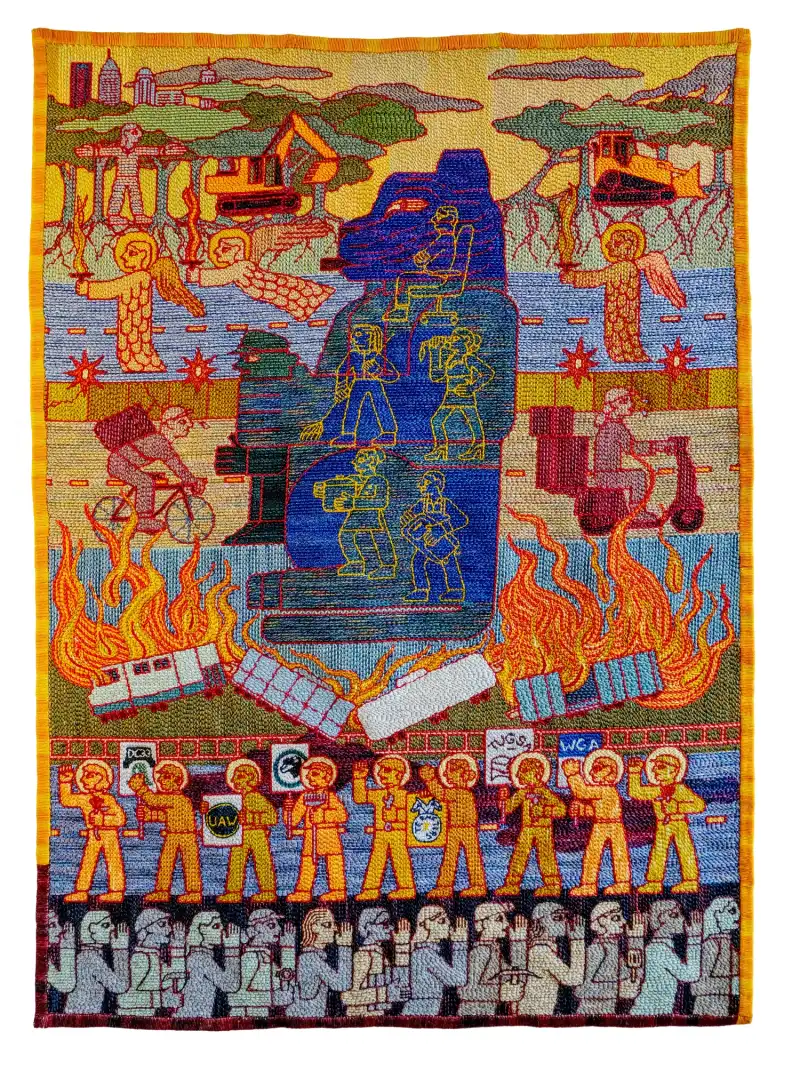
Tabitha Arnold is a textile artist and labour organiser from the United States. She describes her work as “labour-intensive art”: vast punch-needle tapestries, each stitched by hand over some two hundred hours, that render the strikes and struggles of the US labour movement in a style that melds together religious iconography, socialist realism and ancient frieze. Hot Labor Summer (2023) — a wool-on-linen tapestry named for the strike wave that swept the United States that year, from UPS to the auto plants — is among her best-known works. Arnold came to art through organising, having unionised her own Philadelphia café, and her pieces now hang in the Boston Museum of Fine Arts and travel to union rallies on Durham Miners' Gala banner poles.