Briefing
Briefing | No. 32 | When the Bargain Breaks
From South Asia to Southern Europe, social grievances have brought growing masses into the streets. But can popular revolt become political power?
On 23 September, Spanish police evicted 87-year-old Maricarmen Abascal from the Madrid apartment where she had lived for 71 years. After buying her flat, property company Urbagestión had sought to increase Abascal’s rent to more than her monthly pension. Neighbours had prevented three previous attempts to evict her. The fourth succeeded. Abascal was carried out of her home on a stretcher and taken to hospital. The eviction was lawful.
Tens of thousands marched through Madrid in outrage. Protesters occupied Puerta del Sol, erecting more than 1,200 tents, complete with named streets and a makeshift medical centre. They demanded rent controls, protection against eviction and an end to housing speculation. Parliament rejected two emergency housing decrees, prompting Prime Minister Pedro Sánchez to call a snap election for 29 November. On 7 October, Abascal died in hospital, one day before she was due to sign an agreement allowing her to return home.
Across the Pyrenees, a protest that began at a secondary school in a Paris suburb has become a national uprising. Lycée Saint-Exupéry was missing 13 teachers, a deputy head and essential support staff. Students and teachers walked out. Within days, blockades and other disruptions had spread to more than 1,000 schools. At Lycée Paul-Éluard in Saint-Denis, students described rats in the corridors, collapsing ceilings, windows sealed for fear they would fall on pupils, and one nurse for 2,000 students.
On 6 October, over 250,000 people marched across France, as teachers, parents, trade unions and university students joined the school children. Police used tear gas and made hundreds of arrests. The government promised 3,000 substitute teachers, but the protests continued. As one student put it: "We ask for teachers, they send us police.”
On the Indian subcontinent, 6,000 kilometres away, the capital city of Delhi is under siege by its own government. The Modi regime deployed nearly 35000 police to lockdown the city against student protests. More than 2.2 million students sat the national medical entrance examination in May, competing for far fewer places. When questions were found to have circulated in advance, the examination was cancelled. Students who had spent years preparing, and families who had spent their savings supporting them, erupted in anger.
These unemployed graduates and disenchanted youth called themselves the Cockroach Janta Party, reclaiming a disparaging remark from the Chief Justice about unemployed youth as a badge of pride. What began as an Instagram joke with an AI-generated cockroach logo became a mass movement. In July, the protests forced the resignation of Education Minister Dharmendra Pradhan. By October, the movement had joined the struggle against the removal of some 130 million names from India's electoral rolls, which critics accuse the Election Commission of manipulating to benefit Modi's Bharatiya Janata Party.
On 10 and 11 October, police and paramilitary forces sealed roads, closed metro stations and detained protesters demanding the resignation of Chief Election Commissioner Gyanesh Kumar. Denied access to Jantar Mantar, Delhi's designated protest site, demonstrators regrouped at markets, intersections and flyovers across the capital.
In Albania, that fire was sparked from a stretch of barbed wire. This May, developers fenced off access to the coast at Zvërnec, where a luxury resort backed by Donald Trump's son-in-law Jared Kushner threatens the protected Vjosa-Narta wetlands. Villagers produced property deeds and a 2013 court ruling recognising their claim to the land. When residents and environmental activists confronted the development, private security guards dragged them away.
The injustice struck a nerve. The capital, Tirana, has repeatedly been brought to a standstill by protestors carrying inflatable flamingos, the birds whose habitat the development threatens, declaring that “Albania is not for sale". The protests grew into a revolt against corruption and the grip of oligarchs on the country's economy and political system. This week, tens of thousands of students protesting over education and living costs have joined the movement, with clashes leaving dozens injured and arrested. Footage is circulating on social media of citizens being abducted into unmarked vans. Prime Minister Edi Rama refuses to resign.
The historian E. P. Thompson described the moral economy of the eighteenth-century English crowd: shared expectations of legitimate conduct whose violation could turn hardship into rebellion. A fair examination, a functioning school, security in old age, access to public land: in each country, a particular injustice exposed years of accumulated grievances.
The protests have brought down an Indian minister, forced France to promise thousands of additional teachers, removed the fences at Zvërnec and helped precipitate a general election in Spain. But the institutions that produced the grievances — from India's electoral systems to the power of property in Spain and Albania — remain intact. The forces united against a particular injustice may have very different ideas about what should come next.
How can these new rebellions acquire the organised power to change the conditions that produced them?
In Spain, the tenants' movement is already joining forces with the labour movement. At the tenants' unions' initiative, Spain's two largest labour confederations, UGT and CCOO, are backing a 24-hour general strike on 11 November — the first in fourteen years with their joint support. The Madrid Sindicato de Inquilinas has demanded a Decreto Maricarmen to protect tenants against eviction and rent increases, while their allies in Congress have now called for the expropriation of hundreds of thousands of homes held by investment funds for conversion into social housing. General elections in Spain are set for 29 November.
In India, the Cockroach Janta Party is forging links with the organised left and workers' movements. At a joint press conference in Delhi on Thursday, founder Abhijeet Dipke appeared alongside leaders of three Left student organisations — AISA, SFI and AISF — as well as PI Cabinet member Nikhil Dey of the workers' and farmers' organisation MKSS, and Shaik Salauddin of the Telangana Gig and Platform Workers Union, both of whom are also PI Members. Together, they demanded the resignation of the chief election commissioner and an end to the repression of protesters. Opposition parties in the INDIA bloc are pursuing a parallel campaign against the electoral roll revision.
In France, the Union Syndicale Lycéenne has coordinated blockades and demanded €10 billion in emergency education funding. Its president, Ryad Rani, has called on students to join Saturday's Gilets Jaunes mobilisation against the cost of living. Meanwhile, La France Insoumise has challenged police violence against the students in the streets and in parliament and is taking their demands for investment and an end to university selection into the 2027 presidential election.
In Albania, Progressive International’s member Lëvizja Bashkë is building on years of organising among workers, tenants and students to challenge the country's oligarchic order. After winning its first parliamentary seat in 2025, the party has stood alongside the protesters defending the coast, contesting both the luxury development and demanding the repeal of the 2024 legislation that opened protected areas to construction. Many of its members have been beaten and arrested in the protests.
These are the forces that the Progressive International is working to support and connect. Tenant organisations bringing trade unions into a housing struggle. Student movements joining wider coalitions for democratic rights. Political parties emerging from years of workplace and community organising, developing programmes and contesting elections.
Popular anger can spread across a country in days. Building organisations that can confront entrenched interests, withstand repression and win control over political and economic decisions takes years.
Maricarmen Abascal's neighbours stopped three evictions. On the fourth attempt, the property company prevailed with the police enforcing its claim. The task now is to build the power to resist the next abuse, change the laws that enforce them and the ownership they defend.
Brazil's workers win five-day week
On 14 October, Brazil's Senate voted 75–1 to abolish the six-day working week, guaranteeing two days' paid rest and reducing maximum working hours from 44 to 40 without cutting wages. Progressive International member CUT, which mobilised for the reform, hailed it as a historic victory for organised labour. The breakthrough comes ahead of the 25 October presidential runoff between Lula and Flávio Bolsonaro. Meanwhile, Lula's campaign has accused Meta of electoral interference, alleging that its platforms have restricted the reach of pro-Lula content while favouring Bolsonaro, and that its AI tools refuse to generate images supporting Lula while permitting equivalent requests for his opponent. Meta attributes reduced reach to technical problems. Brazil's electoral court has demanded an explanation.
Movements gather in Bangkok to challenge IMF and World Bank
As the IMF and World Bank hold their annual meetings in Bangkok, grassroots movements, trade unions and progressive economists convened a series of counter-meetings challenging the institutions' record of austerity, privatisation and debt dependency. Progressive International representatives are participating alongside members including the Kenyan Peasants League, Pakistan's Haqooq-e-Khalq and Pakistan Kissan Rabita Committee, Council members Walden Bello and Jayati Ghosh, and Blueprint partner Focus on the Global South. The gatherings culminated in a mass demonstration on 16 October demanding economic sovereignty and an end to creditor domination.
Colombia’s workers open a new front against De la Espriella
Thousands of Colombians marched through at least ten cities on 14 October in the first national day of protest against President Abelardo de la Espriella’s government. Trade unions, teachers, students, Indigenous organisations and Progressive International member Pacto Histórico mobilised against cuts to public services, threats to labour rights and new restrictions on protest. In Bogotá, teachers staged a 24-hour stoppage as four marches converged on Plaza de Bolívar. Union leaders are now preparing a possible general strike in November.
8 October 1967 - Che Guevara captured
Ernesto “Che” Guevara was captured in battle in the jungles of Bolivia on 8 October 1967.
Celebrate Che with this clip of his speech to the United Nations.
14 October 1963 - Yemen’s liberation
South Yemen's Marxist National Liberation Front (NLF) launched its liberation struggle against British colonialism on 14 October 1963.
Learn more about this history with this beautifully designed Instagram carousel.
15 October 1987 - Sankara assassination
15 October 1987, Thomas Sankara, the president of Burkina Faso, was murdered in a foreign-backed coup d’etat.
Celebrate Thomas Sankara with this clip of a speech on imperialism.
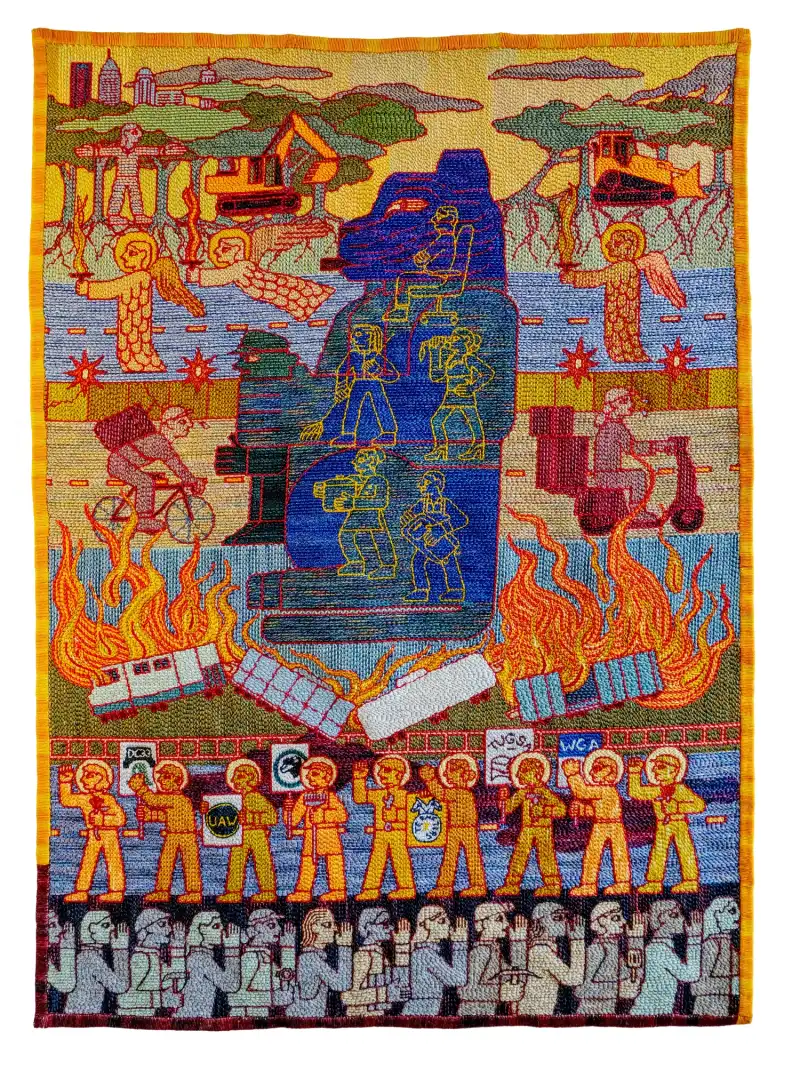
The Longest Revolution is a large scale work of embroidery on cotton textile by Varunika Saraf (1981, India). Saraf is an artist and art historian based in Hyderabad. Her large-scale works, which mainly comprise paintings on Wasli, a painting material from 10th-century India, draw upon a diverse range of archival sources, such as art history, newspapers, and popular culture, to engage in a conceptual dialogue with the past. She does this to critically analyse the predecessors of our contemporary political and social issues, with a specific interest in “the exponential rise in violence”.
Of this work, Saraf has said: “I am interested in women's agency, women as makers of their own futures and agents of socio-political change.” Saraf’s intricate artworks seek to expose the uncomfortable reality of violence by softening the blow through presenting as beautiful paintings. In late 2024, Varunika Saraf contributed an artwork to Progressive International’s limited-edition fundraising poster series, Thieves in the Forest, which speaks to human greed and deep humanitarian and ecological crises. Read more and support Progressive International by buying an edition today.